
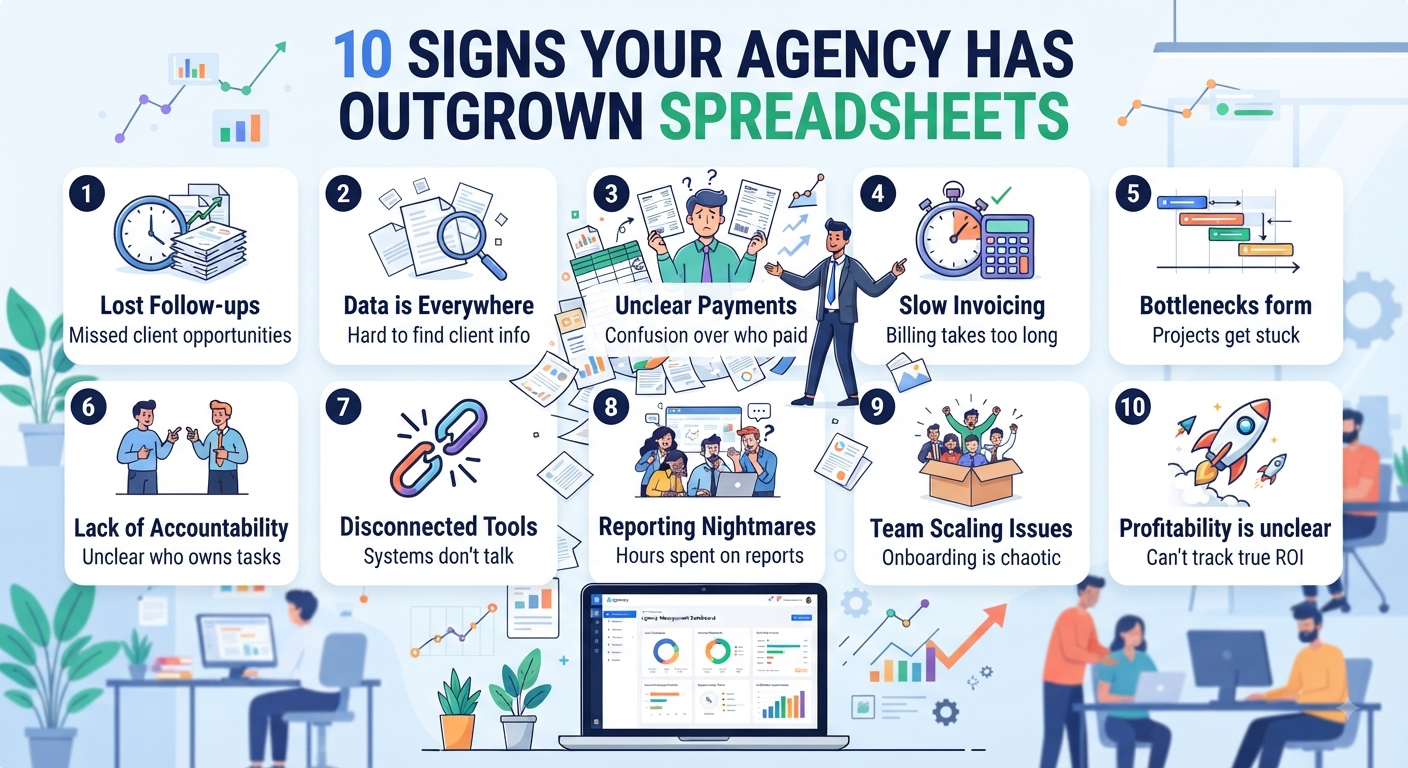
10 Signs Your Agency Has Outgrown Spreadsheets
Spreadsheets are a lifesaver when you're starting out. They keep things organized and simple, but as your agency starts picking up steam, they quickly turn from helpful to headache-inducing.
At first, managing a handful of clients with one spreadsheet feels like you’ve built your own mini CRM. Everything leads, payments, project details all in a couple of tabs. Easy.
But then the agency takes off.
More leads. More clients. The team grows. Projects start overlapping. Invoices pile up, payments come in, expenses shoot up. Suddenly, getting a grip on what’s happening means juggling spreadsheets, WhatsApp chats, emails, random folders, and whatever software you’ve patched together. All just to answer one simple question: “What’s going on in the business right now?"
That’s usually when spreadsheets have done their bit and it’s time for something more connected.
Here are 10 signs your agency needs to break up with spreadsheets.
1. Follow-Ups Keep Getting Lost
Picture this: a lead reaches out. Someone replies, sends a quote, the prospect says, “I’ll get back to you.” A few days go by crickets. Then someone remembers, and a week later, you’re digging through spreadsheets trying to piece it together. The chance may already have slipped.
Spreadsheets can store info, but they can’t really manage the flow. When lead numbers grow, you need quick answers: Who owns the lead? When was the last chat? What’s the next step? If you have to rely on memory for these, the sales process is already shaky.
“I forgot to follow up with that client” hearing this more and more is a big red flag.
2. Client Info Is Spread Everywhere
The phone number’s in one sheet. Requirements? In a WhatsApp thread. Quotation is lost somewhere in a folder. Invoice? Another place. Project details in a Google Doc.
Need a full client history? Now you’re on a scavenger hunt. Duplication, outdated info, and depending heavily on specific people quickly become the norm.
Agencies need one client profile with everything in one place. Instead of bickering about who has what, just open the profile and read.
If your team keeps chasing each other for information, you’ve outgrown spreadsheets.
3. You’re Unsure Who’s Paid and Who Hasn’t
As things get busy, keeping track of payments turns tricky. New invoices, partial payments, overdue balances it starts feeling like detective work just to answer, “How much is still owed?”
Disconnected info means you’re cross-referencing multiple files for a simple answer. A connected workflow ties client, invoice, payment, and outstanding balance together. It's easier, clearer.
Still opening multiple files to check if a client paid? That's a warning sign.
4. Invoice Management Eats Up Too Much Time
Making an invoice is quick. Tracking hundreds over time isn’t.
Someone has to track what’s sent, what’s paid, what’s overdue, who needs a nudge. If your team is stuck manually updating sheets every time something happens, that’s hours lost to admin.
An agency management platform links quotes, invoices, and payments together, streamlining the process. Less manual work, fewer mistakes.
If someone’s job is basically keeping financial spreadsheets alive, it’s time to switch.
5. No One Really Knows Who Owns What
Once your agency is bigger, it’s not just one person doing it all. A project can involve sales, design, development, account management, content, SEO, client approval the whole deal.
Without clear owners, stuff falls through the cracks. The designer thinks the project manager’s got it. The PM assumes it’s the developer. No one really knows.
Ownership should be crystal clear: every lead, project, and task gets a responsible person and a status.
If “Who’s handling this?” becomes a catchphrase, your workflow is out of sync.
6. Project Tasks Are Everywhere Except a Single Place
It’s classic: A client asks for a tweak on WhatsApp. Someone adds a note to Excel. The dev hears a change in a meeting. A reminder’s scribbled somewhere.
No central list, no full picture. The project moves, but you’re never sure what’s left to do.
You want one system to show: tasks, who's doing them, priority, deadline, current status, related client, project. No endless update requests.
If your team always asks for project updates instead of just checking, your system isn’t working.
7. Important Client Data Keeps Going Missing
Every client brings new info requirements, approvals, preferences, payment history. If bits of this are scattered in emails, personal notes, WhatsApp, and random sheets, your agency relies on someone’s memory.
This becomes dangerous when people are unavailable, leave, or clients come back after a while.
One central record protects your business. If only one person knows everything about a client, that’s a risk, not an asset.
8. You Track Expenses, But Profit Stays Mysterious
Revenue is cool but where’s the money going? Freelancer payments, SaaS fees, hosting, domains, advertising, office stuff, travel, contractors it adds up.
If expenses are in a totally separate sheet, comparing them to income is tough. You want a system where revenue, invoices, payments, and expenses come together.
Knowing sales isn’t enough; you want real profit.
If you can't instantly see if your agency is truly making money, spreadsheets aren’t cutting it.
9. Too Many Tools, Not Enough Connection
Look at your workflow. It might be something like: Lead → Excel → WhatsApp → Email → Quotation → Spreadsheet → Invoice Software → Payment App → Project Tool.
Every transfer means someone has to copy, update, or check data that’s where mistakes happen. That’s where work multiplies.
A streamlined workflow should look like: Lead → Client → Quotation → Invoice → Payment → Project → Tasks. The info follows the client, doesn’t get recreated every time.
You don’t need to ditch every tool, but your business basics should be connected.
If your team spends more time moving info than actually using it, you need an upgrade.
10. More Time Managing Work Than Doing Work
Maybe the biggest sign. Ask yourself: How much time goes to updating sheets, hunting client info, checking payments, making reports, sending reminders, copying data, chasing project updates, digging for old chats, following up with teammates?
None of this helps clients directly. Some admin is unavoidable too much admin is a sign your system’s failing.
If your agency is getting busier but not more productive, something’s holding you back.
When Should You Move to an Agency Management System?
There’s no magic client or team headcount. The real question is: Can your current setup actually handle the way your agency works right now?
If you’re facing these problems, you’ve already outgrown spreadsheets.
An agency management system helps connect all those loose ends leads, follow-ups, pipeline, client profiles, quotes, invoices, payments, projects, tasks, team ownership, expenses, services, reports.
The goal isn’t just to ditch Excel. It’s about closing gaps between parts of your business.
Make Your Workflow One Connected System
Imagine logging in and everything’s right there a full snapshot:
- New Leads: Who needs a reply?
- Follow-Ups: Who’s on the list today?
- Sales Pipeline: What’s moving forward?
- Clients: Who’s on deck?
- Invoices: What’s unpaid?
- Projects: What’s active?
- Tasks: What needs done now?
- Expenses: Where’s your money going?
No more bouncing between six spreadsheets, WhatsApp, and emails hunting for updates. You just see it all.
That’s what an agency management system does.
Your Agency Can’t Run on Memory
Small agencies can survive on memory. If you're growing, you need systems.
You shouldn’t need to remember who needs a follow-up, who’s responsible for a task, or where to find a client’s requirements. You shouldn’t have to open endless sheets for payment info. And you definitely shouldn’t depend on one staff member to explain what’s happening.
A solid system turns everyone’s knowledge into one place for the whole agency. Easier to manage, easier to scale, less manual fuss.
Final Thoughts
Spreadsheets aren’t bad they’re just not built to run a fast-growing agency.
At first, they keep things simple. But as clients, projects, payments, tasks, and team size grow, they become just another thing to juggle.
When clients get lost, data duplicates itself, payments go unchecked, invoices take forever to manage, responsibility gets blurry, tasks and notes scatter, info goes missing, expenses stay muddy, tools don’t talk to each other, and admin eats up the day don’t add another spreadsheet.
Connect your workflow. Move from scattered sheets to a unified management system, and give your team the clarity and control they need to focus on what matters: growing the agency.