
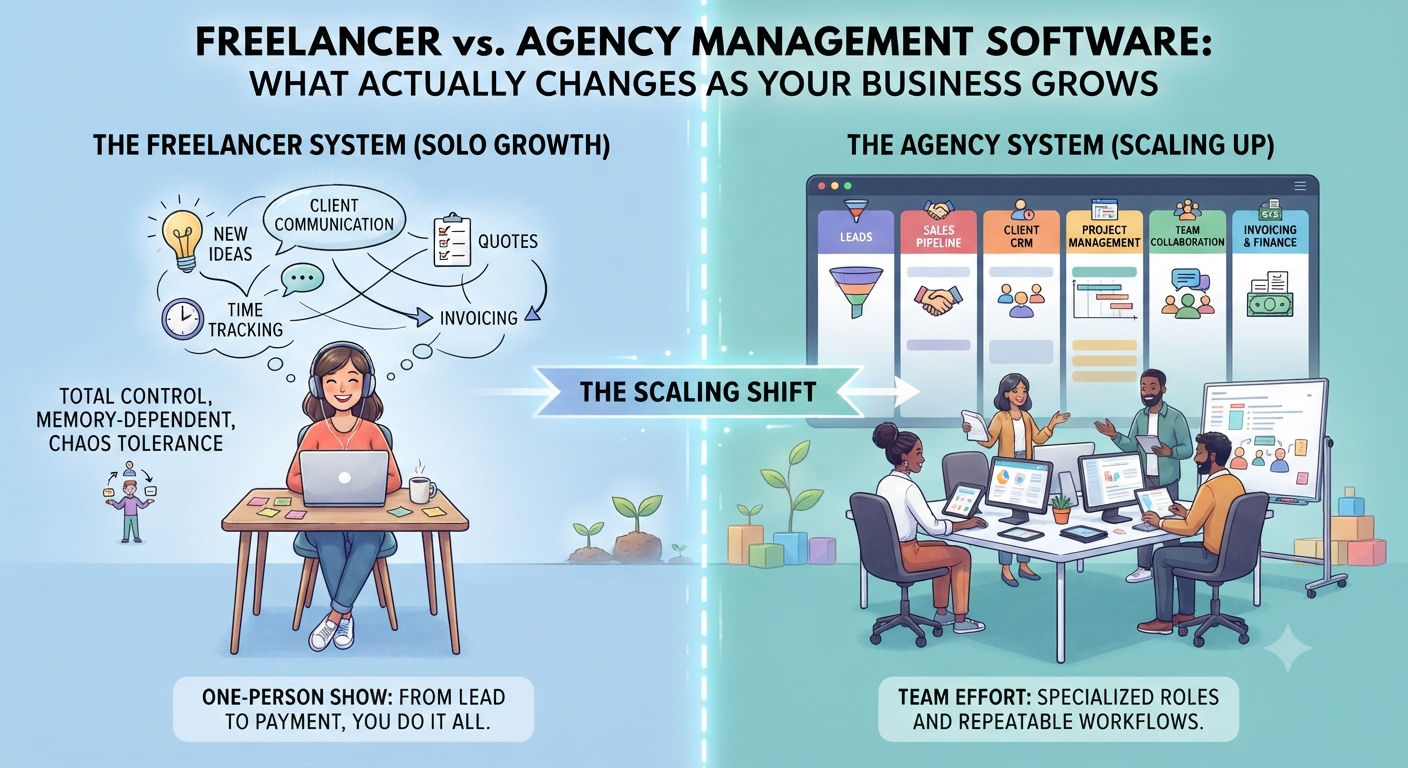
Freelancer vs. Agency Management Software: What Changes as You Grow
If you've freelanced for a while, there's a moment when the work just starts to feel... different.
Early on, everything's simple. A client reaches out. You chat, quote a price, do the job, send an invoice, get paid. You know exactly what’s happening because honestly you’re doing everything yourself.
Then things pick up. Word spreads. More leads come in. Suddenly, you’ve got more clients, more quotes, more invoices, more projects. Maybe you’ve even got someone helping you out now and then.
At first, it’s exciting. You feel like you've made it.
But soon, reality hits: your business is growing faster than how you’re running it.
That’s when things start shifting from a freelancer’s world to an agency’s. And that, honestly, changes everything.
The Freelancer System: You ARE the System
When you’re solo, your mind is basically your whole management software.
You remember who needs a follow-up. Who’s waiting for a quote. Which project’s due this Friday. Who still hasn’t paid. Where you saved the files. What you promised last time you spoke. All the moving parts are right there in your head.
And for a while that works. Your memory handles the load.
But it depends on you remembering everything, all the time. And as soon as more leads, more clients, more projects show up? Memory fails. Cracks appear. Mistakes creep in.
That’s when things start slipping.
What Actually Changes as You Become an Agency
The big change isn’t just about hiring people. It’s losing that total control you can’t touch every single part of the business anymore.
Think about it:
Freelancer workflow:
Lead → You → Client → You → Project → You → Payment
Agency workflow:
Lead → Sales → Quotation → Client → Project → Team → Review → Invoice → Payment
Suddenly, info passes between people instead of living in your brain. You need real processes, or chaos takes over.
1. More Leads, Real Sales Pipeline
Five leads? No problem. WhatsApp, email, maybe a spreadsheet.
Fifty leads? That’s a problem.
Now you need to know: Which are brand new? Who got a call? Who needs a follow-up? Who has a quote waiting? Which ones turned into clients? Where are your best leads coming from?
Without a system, leads disappear just because someone forgot to follow up.
Agency management software turns random requests into an actual pipeline:
New Lead → Contacted → Qualified → Quoted → Negotiation → Won/Lost
No more team members asking “Hey, what’s up with this lead?” They just check the system.
2. More Clients Means More Details
Five clients? Manageable.
Twenty? You need to get organized.
Fifty? Get a system, or get ready to lose your mind.
Each client could have different requirements, pricing, projects, contacts, documents, payment terms, history, deadlines, team members. If that info’s scattered across chats, inboxes, and random folders, your team will waste hours just finding things.
A proper client management system gives everyone one place for truth.
When anyone checks a client record, they can instantly see: Who they are. What you’ve sold them. What’s in progress. What they’ve paid. What’s pending. Who’s handling it.
That’s not just storing details. That’s real relationship management.
3. Quoting Becomes a Workflow, Not Just a Document
Making quotes was easy when you started. Make it, email it, done.
But with 20 or 50 quotes at different stages? Some new, some in negotiation, some approved, some stuck waiting on a deposit it gets messy.
Now, it’s not the quote itself, but tracking where each quote stands that’s tricky.
A good system connects each quote to the right client, shows the quote’s status, and automatically creates the next step like turning an approved quote into a project.
Lead → Quote → Approval → Project
You avoid duplicate work and things falling through the cracks.
4. More Invoices, More Chasing Money
Landing a project isn’t the same as actually getting paid. As you scale, invoice management shifts from “I’ll remember” to “Wait, who still owes us?”
You need instant answers: Which invoices are unpaid? What’s overdue? Which clients have balances? What’s due this week? What’s collected?
Handle all this by hand, and follow-ups get sloppy. Cash flow suffers.
With the right software, you don’t have to keep it all in your head. You log in, and see who owes what. You can follow up before money slips through the cracks.
5. More Projects, More Chaos (Unless You Get Organized)
Here’s where most people feel the pain. One project? Easy. Five? You can juggle. Fifteen active at once? Things get wild quickly.
Each project comes with its own tasks, deadlines, milestones, team, files, approvals, revisions you name it.
Try tracking all that in WhatsApp and spreadsheets, and you’re in trouble. Deadlines get missed. Info goes missing. People keep asking you the same questions and suddenly, you’re the bottleneck.
A real project management workflow lets projects move forward even if you don’t personally jump in on every detail.
6. Hiring: Now You Need Permissions
Your first hires developer, designer, salesperson are a huge moment.
But hiring brings a new thing to manage: access.
When you’re on your own, no big deal. Once there’s a team, you can’t let everyone see or change everything.
Does your designer need to see invoices? Should a salesperson edit client info? What about deleting projects? Who can access financials?
You need roles and permissions, for example:
- Super Admin – Everything
- Admin – Ops.
- Sales – Leads, clients, quotes
- Project Manager – Projects, team
- Finance – Payments, invoices
- Team Member – Just their tasks
Give each person what they need nothing more.
7. More People, Repeatable Processes
As a freelancer, you can work differently every day.
With a team, you can’t. If everyone runs things their own way, you get unpredictable results.
One person updates a lead, another forgets. One follows up, another thinks someone else did. Pretty soon, no one really knows what’s going on.
That’s why agencies create standard operating procedures not to make things complicated, but so important stuff doesn’t get lost.
- Lead comes in.
- Assigned to someone.
- Follow-up.
- Quotation sent.
- Approved.
- Project created.
- Team assigned.
- Project delivered.
- Invoice sent.
- Payment in.
It’s not about being rigid. It’s about making life predictable for everyone.
Freelancer vs Agency: The Core Difference
Here’s the simple version:
- Freelancer: You manage the work. The info’s mostly in your head. Small number of leads, clients, quotes, invoices, projects. You do most tasks.
- Agency: You manage the system. Info must be accessible to your team. Big pipeline. Structured client+project management. Quote and invoice tracking. Many projects, tasks split between people. Multiple users with permissions. Repeatable workflows.
This isn’t just about business size it’s a management shift.
Do You Need Agency Software Right Now?
Not always. If you’re coasting with a handful of clients and simple processes, a complex system might actually slow you down.
But watch out for these warning signs:
- Missing lead follow-ups
- Forgotten or lost quotes
- Unclear which projects are active
- Clients asking for updates you can’t answer
- Team always pestering you for info
- Spreadsheet overload
- Payment follow-up struggles
- Too many people, too little clarity
- You feel you’re the only one who knows what’s going on
When these keep happening, the problem isn’t “work harder” it’s you need a better system.
Don’t Build Your Agency on Memory Alone
This is the big freelancing-to-agency lesson.
Your business can’t depend on you remembering everything. You shouldn’t have to keep in your head:
“I need to call him.”
“Did we send that quote?”
“Did they pay?”
“Who’s doing this project?”
“Where did I save that?”
“Is that task done yet?”
The bigger you get, the more costly those little gaps become.
A system makes each responsibility a visible process easier to delegate, track, and improve.
Growing Agencies: More Revenue, Not More Confusion
Growth should mean:
More leads, clients, projects, revenue, and people.
It shouldn’t mean:
More confusion, spreadsheets, missed follow-ups, WhatsApp chaos, manual work, or you becoming the single point of failure.
Agency management software isn’t just about replacing spreadsheets. It’s about building a structure that actually scales.
When leads grow, your sales workflow handles it. When clients grow, your CRM keeps them sorted. More quotes? Pipeline shows the status. More invoices? The system highlights what’s unpaid. More projects? The workflow keeps everyone on track. More team? Permissions keep things secure.
Build Systems Before Growth Gets Messy
You don’t need to wait for 50 employees to get serious about systems. Actually, it’s a lot easier to build them while you’re small.
So: document your processes. Organize your client info. Track leads. Standardize quotes. Manage invoices. Create repeatable project workflows. Set permissions.
Then, when the business takes off, you’re not scrambling or reinventing everything you’re just scaling up what already works.
Because the real goal isn’t to need more people to handle chaos. It’s to have the right systems so the people you hire can actually do their best work.
That’s the difference between a freelancer who’s overwhelmed, and an agency that’s ready to grow.
Start building systems before growth turns into chaos. Your future self will thank you.