
How to Build a Repeatable Sales Process for Your Digital Agency
You might have an agency loaded with talent, great services, and a steady stream of new leads. But sales will always feel shaky if everyone handles leads their own way.
Maybe one lead gets a reply in minutes, but the next waits two days for a response. One client gets a quote right after asking, while another has to send three reminders just to see some numbers. Someone remembers the invoice this week, while someone else lets it slip.
These small lapses add up. Pretty soon, your sales process is just a bunch of people hoping they’ll remember what to do next. That’s a recipe for stress.
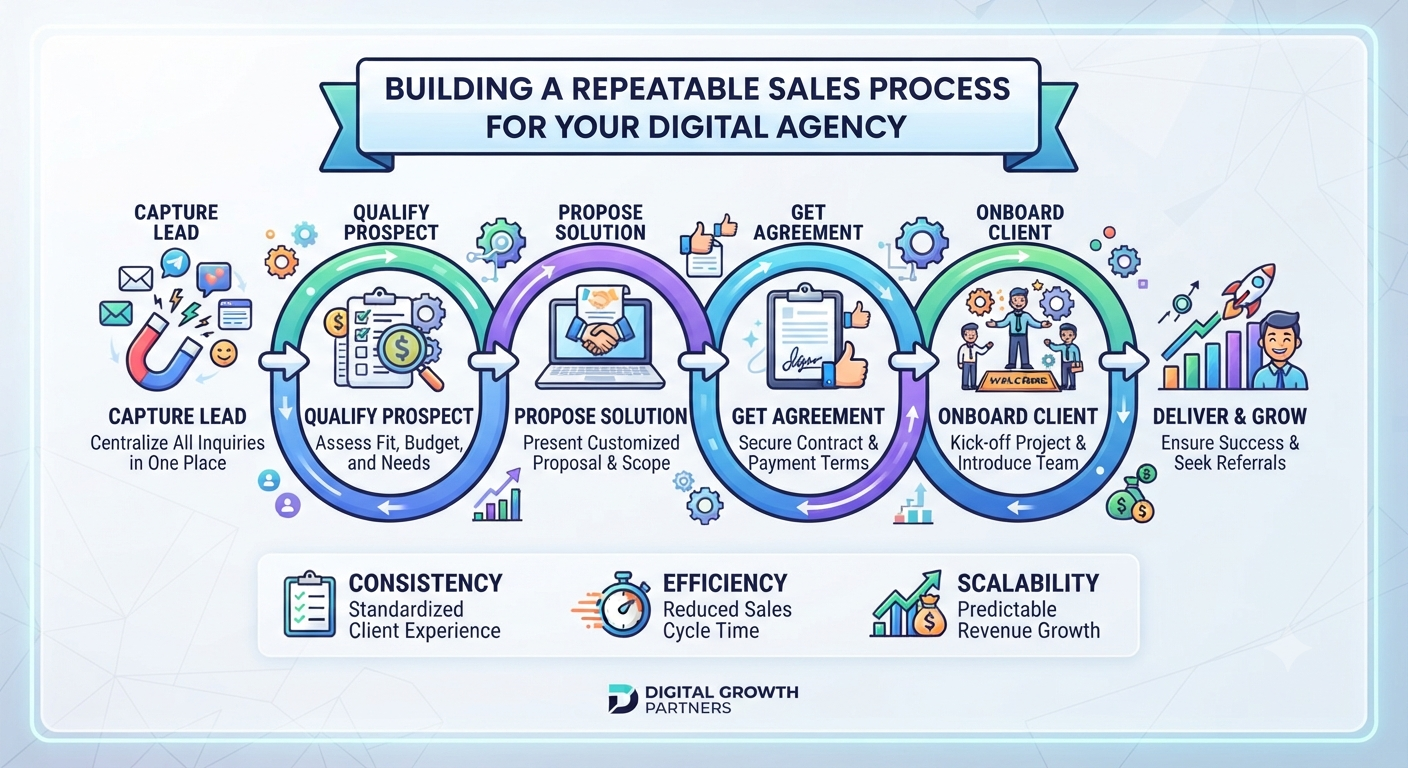
What you really need is a repeatable sales process a set way of working so everyone knows what happens from the initial lead all the way to the money you actually collect.
At its core, the journey looks like this:
Lead → Follow-up → Quote → Approval → Invoice → Payment
This isn’t about making your agency more complicated. It’s about making sales straightforward, so your team isn’t constantly figuring things out from scratch.
Why a Repeatable Sales Process Matters
When your agency is small, you know every lead. You remember who needs a follow-up. You know which invoices haven’t been paid.
But it doesn’t take much for things to get messy once the client count goes up. Suddenly, you’ve got conversations spread across emails, WhatsApp, phone calls, your website, and social DMs. Missed steps become a real risk.
A clear, repeatable process gives your team a go-to way of handling every opportunity. Instead of guessing what comes next, they just follow the steps.
This means fewer mistakes, faster responses, and the peace of mind that comes from knowing the process doesn’t hinge on anyone’s memory.
1. Capture Every Lead in One Place
It all starts the moment someone reaches out. Maybe it’s from your website form, a DM on Instagram, a phone call, a Facebook message, a referral, or an email. Don’t stress about the source just make sure every lead lands in one system.
At the very least, you should capture:
- Name
- Business
- Contact info
- Service they’re interested in
- Where they came from
- When they reached out
- Who’s handling it
- Where things stand
- When the next follow-up’s due
Bottom line: No lead should live in someone’s random WhatsApp chat. If it’s in your system, your team knows whose responsibility it is and what needs to happen.
2. Create a Clear Follow-Up Process
Getting a lead is just the beginning most clients won’t sign off after the first chat. They’ll want time to think it over, talk to their boss, check their budget, all of that.
You can’t just follow up whenever you remember. Instead, nail down a simple, step-by-step plan. For example:
- Day 0: Respond right away
- Day 1–2: Understand exactly what they need
- Day 3: Send info or a proposal
- Day 5: Check in
- Day 7: See if they have any last questions
- Later: Set future reminders if they’re still deciding
You don’t have to copy this exact timeline, but everyone should know who’s following up, when, and what the next step is. And please, don’t just nag them with “Any updates?” Add some value clarify needs, answer questions, give examples, or explain what happens next. That’s how you stay in the game without being annoying or letting good leads slip away.
3. Turn Requirements Into a Professional Quote
Once you know what the client needs, send a quote that actually explains the project not just a dollar amount.
A good quote should spell out:
- What you’ll do
- How long it’ll take
- What it’ll cost
- Payment terms
- How many changes or revisions they get
- What you expect from them
- If there are any extra possible fees
- How long your offer’s good for
- What they need to do to say “yes”
Answer these three questions in your quote: What will you deliver? How much will it cost? What’s the next step after approval? When you’re clear on these, you avoid back-and-forth and show you’re running a tight ship.
4. Make Approval a Defined Stage
Sending the quote doesn’t mean the project is a done deal. You need a clear stage for approval.
Track each opportunity as it moves:
Quote Sent → In Discussion → Approved
Once a client gives the green light maybe by email, clicking an online approve button, signing the quote, or just saying so on WhatsApp log that approval somewhere everyone can see. Don’t let the “yes” get lost deep in some chat thread.
Your sales system should show, at a glance: which quotes are waiting for approval, who’s said yes, who’s still thinking. As you grow, you’ll be grateful to have this clarity.
5. Generate the Invoice Without Starting From Scratch
The minute a client approves, don’t waste time creating invoices from zero. Pull all the info you’ve already collected client details, project specs, costs, payment terms right into the invoice.
This helps you avoid mistakes like wrong client names, numbers that don’t match the quote, missing tax lines, and so on. Data should only need to be typed in once, ever. This also keeps your invoices consistent and saves your team a ton of time.
6. Make Payment the Final Trackable Stage
An invoice means nothing if you can't track payments. Set up a simple flow:
Invoice Sent → Payment Pending → Payment Received
Make sure your team can spot unpaid invoices, partial payments, overdue accounts, which jobs can start, and who needs a reminder. When you’re juggling lots of projects, these details matter.
As soon as a payment comes in, that project should move to the next step either automatically or with the click of a button. Keep things moving.
The Complete Agency Sales Process
Here’s how it all comes together:
Lead
↓
Lead Qualified
↓
Follow-Up
↓
Requirements Confirmed
↓
Quotation Created
↓
Quotation Sent
↓
Approval
↓
Invoice Generated
↓
Payment Pending
↓
Payment Received
↓
Project Handoff
This gives everyone the same map for how a sale moves from start to finish. No more mystery about what’s supposed to happen next.
Don't Build a Process That Exists Only in Your Head
One of the biggest roadblocks for agencies on the rise? The founder runs everything from memory. You remember who needs a follow-up, which quote is out, which client is slow to pay.
But as you grow, this breaks down. The business starts to depend on one brain, and that person ends up swamped.
A scalable agency moves the process out of people’s heads and into the open. Write things down. Make them visible and repeatable. That way, a new team member doesn’t have to keep asking you what needs to happen they look in the system and see for themselves.
What happened? What’s going on? What’s next? It should all be there.
Automation Makes the Process Even Stronger
Once you’ve got the basics in place, automation picks up the routine stuff.
For example:
- A new lead gets assigned automatically.
- Reminders go out when follow-ups are due.
- Client says yes? The system generates an invoice right away.
- Send a payment link as soon as the invoice goes out.
- When payment comes in, the system marks it.
- If someone’s late paying, they get a reminder no one has to remember to chase them.
You don’t have to automate everything just the repetitive admin work. That frees your team to actually sell, strategize, and deliver results.
Build the Process Before You Need It
When you only have a handful of leads, a process might feel unnecessary. But once things pick up, you’ll wish you had one.
More leads means more conversations, more follow-ups, more quotes and invoices and so much more that can slip through the cracks. If you’re not careful, growth turns into chaos.
But if you’ve got a repeatable process, growth is a lot less stressful.
Final Thoughts
A digital agency doesn’t need a monster sales machine. What you really need is a simple, repeatable process.
From first lead right through to payment, every stage should have a clear action, an owner, and a status.
The big payoff isn't just better organization it’s the consistency, the transparency, and the ability to scale without everything coming back to one person’s brain.
When the process lives in your business (and not just in someone’s head), your team works with more focus, and your agency can grow without you being the bottleneck.
Stop winging it. Build the system. Because it’s not just about getting more leads it’s about knowing what to do with every one.