Agency Management Software vs. Juggling Multiple Tools
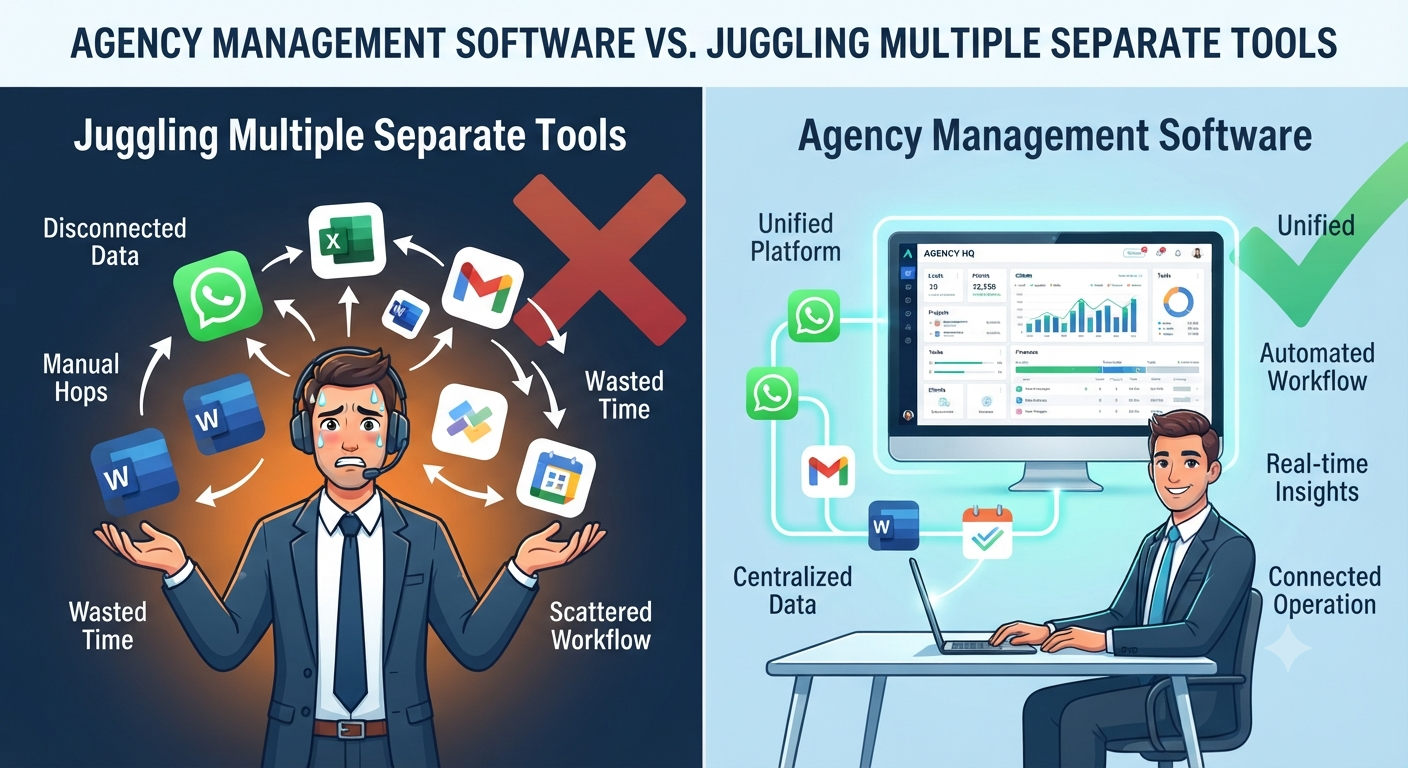
Running an agency these days often feels like spinning plates. You’re tracking leads on WhatsApp, entering details into Excel, chasing requirements by email, drafting quotes in Word, checking payments through your banking app, assigning tasks in a management tool, and slotting meetings into your calendar. At first, it all feels manageable. Every tool does what it’s supposed to do. WhatsApp keeps the conversation flowing, Excel makes data entry quick, Gmail organizes your emails, Word handles documents, banking apps keep an eye on your money, task management tools get everyone focused, and calendars stop you from missing deadlines.
But pretty quickly, you notice something’s off none of these tools know what the others are doing.
All the important info your agency runs on is scattered. As you add more clients and work scales up, keeping track gets messier. The more you grow, the more you realize just how much time you’re wasting piecing everything together. Agency management systems aim to fix this by connecting the crucial parts of your workflow so you can manage your entire business from one place.
It’s Not About How Many Tools You Use It’s About How They Fit Together
Truth is, there’s nothing wrong with having lots of software. Most agencies need specialized tools for specific tasks. The real headache starts when your team has to manually carry info from one tool to another all day long.
Picture the usual client journey: a potential client sends a WhatsApp message. Someone enters the lead into Excel. The sales team follows up through WhatsApp or Gmail. If the client’s interested, a quote gets created in Word, then emailed out. After approval, payments are checked in the banking app. Once that’s confirmed, someone builds a project and divvies up tasks. Deadlines are tossed onto the calendar.
Now do all that for 20, 50, or 100 clients and suddenly, moving info from tool to tool turns into a full-time job. The problem isn’t with each tool, it’s with all those manual hops in between.
Hidden Busywork Eats Up Time
Disconnected systems pile up work you’ll never see on a project plan. Someone’s copying details. Someone’s updating spreadsheets. Someone’s digging through old WhatsApp threads for missing info. Someone’s hunting for the right quote. Someone’s confirming the payment. Someone’s briefing the project team, and someone else is updating task statuses or planning the next follow-up.
None of this actually grows your business. But it chews up hours every day and that’s the hidden cost agencies rarely see coming.
What Changes With an Agency Management System?
An agency management system ties everything together. Instead of managing every step separately, your workflow actually follows a real path: Lead → Client → Quotation → Approval → Payment → Project → Tasks → Delivery → Follow-up.
So when a lead becomes a client, the team doesn’t have to retype info somewhere else. When a quote gets the green light, everyone knows what happens next. Starting a project? The team can see what the client bought, what’s due, who’s responsible, and what’s left. The big idea is simple: connect the info so your team stops wasting time on system wrangling and starts focusing on moving projects forward.
WhatsApp Keeps the Conversation Going But Business Needs More Than That
WhatsApp is basically the lifeblood of client communication for most businesses. Clients send requirements, images, documents, approvals, questions, updates, and payment confirmations over chat. But what’s sent is not always what gets remembered.
Stuff can vanish down the thread, and one person might know the details while others are in the dark. An agency management system keeps critical business records accessible for the whole team, not just locked away in individual conversations. Use WhatsApp for quick chats use your agency management system for everything that needs clarity and context.
Excel Is Great Until It Isn’t
Excel serves small businesses well: flexible, affordable, and easy. But as your agency grows, that single leads sheet multiplies leads, clients, quotes, payments, projects, tasks. Now someone’s gotta keep every sheet in sync. Clients might be marked “converted” on one sheet, but “active” somewhere else. Payments get logged, but project records stay stale. Phone numbers change in one file, but not the others.
The issue isn’t Excel itself it’s trying to run an agency on isolated spreadsheets that can’t talk to each other.
Email and Documents Only Add Another Layer of Separation
Agencies rely on email and docs but when approvals, quotes, and project notes are spread across endless threads and files, reconstructing a client’s history turns into detective work.
Imagine a client asking, “What exactly did we agree on?” Your team scrambles through Gmail, searches folders for quotes, checks WhatsApp, and maybe asks the person who handled the client last. A connected system keeps all operational records together, so you don’t have to rely on email archaeology every time someone needs context.
Payments Need Context Not Just Bank Data
Banking apps show you what moved in and out. But your agency needs to know which client paid, which invoice it was for, what’s still owed, if the project can move forward, and if the client has more payments pending. When payments and client info are separate, someone has to connect the dots manually.
With a centralized system, everything lines up: payments link to clients, quotes, invoices, and projects. Now your finance team sees what’s paid, what’s pending, and what actions to take.
Tasks Should Meaning Something Not Just "Do This Thing"
A task like “Create website homepage” is nice, but it lacks critical context. Your team should always know which client the task is for, which project, what’s been promised, deadlines, who’s on it, what’s already done, client notes, payment status, and next steps.
Connected systems make every task part of a bigger story. No task should be floating without a clear link to the business activity behind it.
One System = One Clear View of Your Business
Here’s the big payoff: an agency management system gives you visibility. You don’t have to open ten apps and chase down seven people to see where things stand. You just look at the central dashboard.
Want to know:
- How many leads came in?
- Who needs a follow-up?
- Which quotes are waiting?
- Which clients have unpaid invoices?
- What projects are live?
- Which tasks are overdue?
All that and more gets organized in one spot. You go from collecting info to actually managing the business.
More Software Doesn’t Equal More Control
Agencies grow and often reach for new tools: add a CRM, a project manager, an accounting platform, another communication app, another integration. Pretty soon you’ve got a dozen applications, but the operation feels even messier.
Adding software doesn’t automatically mean a better business. Sometimes, it just means more confusion. The real question is: How well are your systems connected? Sometimes, fewer tools that talk to each other are easier to manage than a bunch of disconnected apps.
Scattered vs. Connected Workflow
Scattered Workflow (Multiple Tools):
Lead → WhatsApp → Excel → Gmail → Word → Banking App → Task Tool → Calendar.
Every step is a manual hop.
Connected Workflow (Agency Management System):
Lead → Client → Quotation → Approval → Payment → Project → Tasks → Delivery → Follow-up.
Each stage flows into the next without missing context.
Visibility Is Everything
As an agency owner, you need clear insights. You shouldn’t have to track down everyone for basic updates. How many new leads? Who needs follow-up? Which quotes are stuck? Who hasn’t paid? What projects and tasks are late? What needs action today?
When this info is scattered, it takes forever to answer those questions. If it’s connected, you’re in control.
One Connected System Doesn’t Mean Ditching All Other Apps
Don’t worry you’re not tossing WhatsApp, Gmail, banking platforms, calendars, or other specialist tools. Keep what works. The agency management system just becomes your operations HQ, tying everything together.
Think of it like this: specialized tools handle core jobs. The management system organizes your workflow across them. That beats trying to replace every tool your team already uses.
Fewer Disconnected Workflows, More Real Progress
The point of agency management software isn’t to shrink your app list. It’s to cut down disconnected processes. Instead of “Find → Copy → Update → Search → Confirm → Update Again,” you get “Capture → Connect → Track → Act.” That difference becomes a lifesaver as your agency keeps growing.
When Should You Consider Agency Management Software?
There’s no magic number for team size or revenue when you must switch. But you’ll see signs:
- Leads spread across spreadsheets.
- Client info buried in WhatsApp.
- Teams always asking for updates.
- Making quotes from scratch every time.
- Payment follow-ups rely on memory.
- Everyone keeps their own version of data.
- You spend ages checking different apps.
- Uncertainty about what’s happening.
- Missed client follow-ups.
If this sounds familiar, it’s not that your team needs to work harder it means your workflow needs structure.
Build Your Agency Around a Connected Workflow
Your agency’s most valuable information shouldn’t be locked away in silos. Leads should flow to clients, clients to quotes, quotes to payments, payments to projects, projects to tasks, and tasks to people and deadlines. Every activity builds a story your team can follow.
This creates a connected chain: Lead → Client → Quote → Payment → Project → Task → Delivery → Follow-Up.
It’s way easier to manage than trying to stitch together a story from WhatsApp messages, Excel files, emails, docs, banking apps, and calendars.
Final Thoughts
It’s normal for agencies to use lots of tools. The trouble starts when your workflow depends on people stitching those tools together all the time. A lead in WhatsApp shouldn’t be left floating. A quote in Word shouldn’t live in isolation. A payment shouldn’t trigger a scavenger hunt for the right project. A task shouldn’t exist without a client, deadline, and goal attached.
Agency management software’s true value isn’t just more features. It’s about connecting all the information you already depend on. When workflows are connected, your team spends less time hunting, copying, updating, and fixing data and more time growing your business.
Stop running your agency as a patchwork of separate spreadsheets, conversations, documents, emails, payment records, tasks, and calendars. Build a connected system that brings your agency’s core operations together, so you can manage with clarity and see everything that matters.