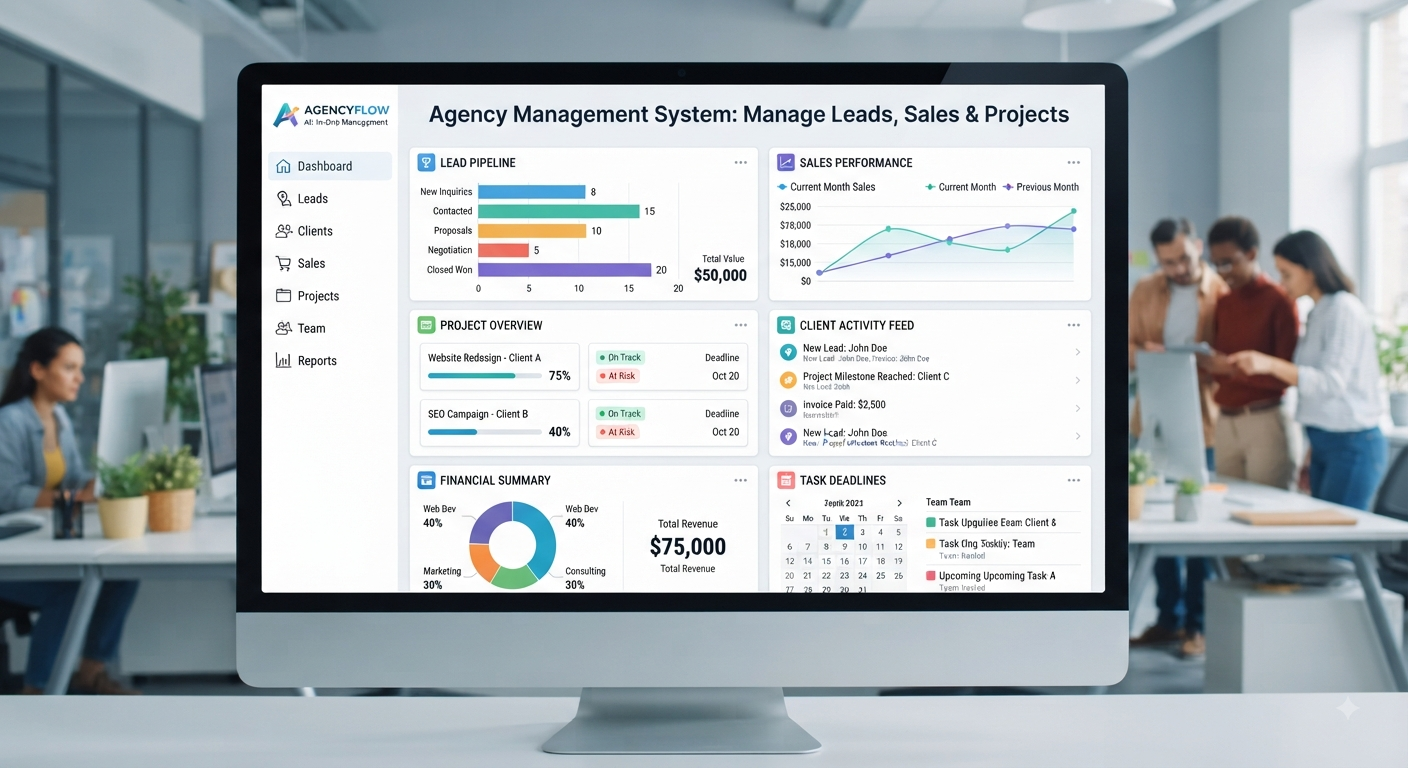
Agency Management System: Manage Leads, Sales & Projects
Running an agency isn’t just about doing good work for your clients. You’re juggling leads, follow-ups, clients, quotes, invoices, payments, projects, employees, expenses plus all those daily fires that pop up. For a freelancer or a small agency, it gets overwhelming fast if you’re chasing info through Excel files, WhatsApp threads, random emails, and a bunch of different apps.
An Agency Management System pulls all these pieces together. Instead of patching things together across separate tools, you can handle everything from one spot.
What’s an Agency Management System?
It’s a business platform built for agencies, connecting the whole operation from finding new leads, all the way through to delivering projects and tracking payments.
Here’s what it covers:
- Lead and CRM management
- Client records
- Sales and follow-ups
- Quotes
- Invoices and payments
- Services and packages
- Project management
- Tasks and deadlines
- Hosting details
- Expenses
- Content management
- Users and teams
- Calendars
The goal? Make sure your workflow is smooth and your agency stays organized.
Why Agencies Need a Centralized System
Plenty of agencies start simple: leads in spreadsheets, client chats on WhatsApp, quotes in Word docs, invoices somewhere else, and project tasks through email or messages. It works sort of if you’ve got just a handful of clients. But once things pick up, cracks start showing.
You forget to follow up. Payment deadlines slip. Tasks vanish. And you waste time hunting for client info.
A centralized system fixes that. Everything’s connected. No more asking yourself, “Where’d I save that quote?” or “Did anyone check in with that client?” You just log in and it’s all there.
Manage Leads with CRM
Every agency wants a steady stream of new business, but keeping track is tough unless you have a proper CRM (Customer Relationship Management) module.
Here’s what you can store:
- Contact names, numbers, emails
- Company info
- Lead source
- Who’s handling the lead
- Potential value
- Status
- Notes and follow-up history
Move leads through the pipeline: New → Contacted → Qualified → Quoted → Negotiation → Won/Lost. It helps you see exactly how your sales funnel is doing.
Follow-Ups Matter
Getting a lead isn’t enough. If you don’t keep checking in, that potential client just fades away. A good management system lets you log past follow-ups, schedule next steps, and track all communication. So you won’t lose out just because someone forgot to call.
Manage Clients in One Place
When a lead turns into a client, don’t waste time re-entering their details somewhere else. A centralized setup keeps everything together:
- All their info
- Contacts
- What they bought
- Quotes, invoices, payments
- Project history
- Tasks
- Notes, communication records
Your team sees the full client picture: what you’ve delivered, what’s paid up, what still needs doing.
Simplify Sales and Quotations
Making quotes shouldn’t be a headache. With your services listed right in the system, you can build quotes in minutes.
Quotes can include:
- Client info
- Chosen services/packages
- Quantity, price, discounts, taxes
- Terms, expiration
Track each quote’s status: draft, sent, approved, rejected, expired. Your sales team always knows where things stand.
Invoice & Payment Management
Landing a client is great but getting paid matters even more. If quotes, invoices, and payments are all tied together, everything’s easier.
You track:
- Invoice status
- How much is paid and what’s still owed
- Payment dates and methods
- Due dates, reminders
- Payment history
No more chasing payments or missing overdue bills.
Organize Services & Packages
Agencies usually offer a mix web development, SEO, design, social media, content, hosting, maintenance, marketing, and so on. Stop re-entering the same details. Make a central catalog of services and packages.
For example, a "Business Website Package" could include:
- Website design and dev
- SEO basics
- Hosting & maintenance
This speeds up quoting and keeps pricing consistent.
Project Management After the Sale
Once the quote’s accepted and payment’s in, the real work starts. A project management module lets you track:
- Project names
- Clients involved
- Start dates, deadlines
- Status
- Assigned team
- Tasks and deliverables
- Progress, notes
Now your team can collaborate from a shared project space, no more tracking stuff through random messages.
Manage Tasks & Deadlines
Projects break down into tasks. For a website job, you’ll:
- Gather requirements
- Build a sitemap
- Design pages
- Develop site
- Add content
- Test
- Get client review
- Tweak, launch
Assign tasks to people, track status (To Do, In Progress, Review, Done), and prevent important steps from slipping through the cracks.
Organize Hosting & Maintenance
Agencies running websites need to keep tabs on:
- Domains, hosting plans
- Renewal dates
- Client sites
- Hosting fees
- Maintenance jobs
Keeping all this in your central system makes renewals and recurring services much easier.
Track Agency Expenses
Revenue sounds nice, but expenses are what really show your profit. An expense module helps you track:
- Hosting costs
- Software
- Advertising
- Freelancers
- Office overhead
- Domain expenses
- Project-specific spending
With organized records, you get a clear picture of project profits and overall business health.
Content & Deliverables
Content’s a big deal for lots of agency projects websites, blogs, social media posts, designs, marketing materials, approvals, deadlines.
Attach content tasks to clients or projects, so everything stays visible and confusion drops.
Users & Roles
As your agency grows, more people need access, but not everyone should see everything. Role-based permissions control who can do what:
- Admin: Everything.
- Sales: Leads, clients, quotes.
- PM: Projects, tasks.
- Accounts: Invoices, payments, expenses.
- Team: Assigned work.
Keeps things secure and tidy.
Central Calendar
Agencies juggle dates: meetings, follow-ups, deadlines, payments, renewals. Bring them all together so your team isn’t lost checking different calendars.
The Complete Agency Workflow
The real magic is how it all connects. Not just standalone features, but a smooth process:
Lead → CRM → Follow-Up → Qualified → Quote → Approval → Invoice → Payment → Project → Tasks → Delivery → Client
Plus everything else: services, expenses, hosting, content, team, calendar all linked.
Benefits of One Platform
- Save time — cut repetitive work and tool-switching.
- Never miss a lead or follow-up.
- Track cash flow — see quotes, invoices, payments at a glance.
- Boost accountability — everyone knows their jobs and deadlines.
- See the big picture — sales, projects, finances, all clear.
- Reduce mistakes — avoid duplicate data and missing files.
- Grow faster — add clients, services, employees as you expand.
Using One System vs. Lots of Tools
Separate tools aren’t evil, but they don’t talk to each other. You end up with Excel for leads, WhatsApp for chats, Word docs for quotes, a separate tool for invoicing, email for approvals, task software, calendar apps it’s messy. You’re constantly moving info around.
An agency management system connects everything one place, one source of truth.
Who Should Use an Agency Management System?
It works for:
- Digital agencies
- Web dev companies
- SEO shops
- Marketing teams
- Design studios
- Social media agencies
- Freelancers
- Consultants
- Small businesses
- Startups
You don’t have to be huge. Organized systems make growth easier right from the start.
What to Look For
Before picking a platform, focus on more than features:
- Centralized info: Keep everything connected.
- Easy workflow: Teams shouldn’t need hours of training.
- Automation: Follow-ups, quotes, invoices handled simply.
- Scalability: Grows with your business.
- Role-based access: Control permissions.
- Reporting: Track sales, projects, payments, performance.
- Integrations: Sync with tools you already use.
Final Thoughts
Running an agency just works better when everything’s organized. Leads connect to clients, clients to quotes, quotes to invoices and payments, payments to projects, projects to tasks, people, deadlines.
That’s what an Agency Management System does.
It’s not just another CRM or project tracker. It’s your agency’s backbone.
With one central platform, your team stops hunting for info and starts focusing on making sales, delivering work, and actually growing.
Manage leads, clients, sales, projects, payments your entire agency all from one place.