
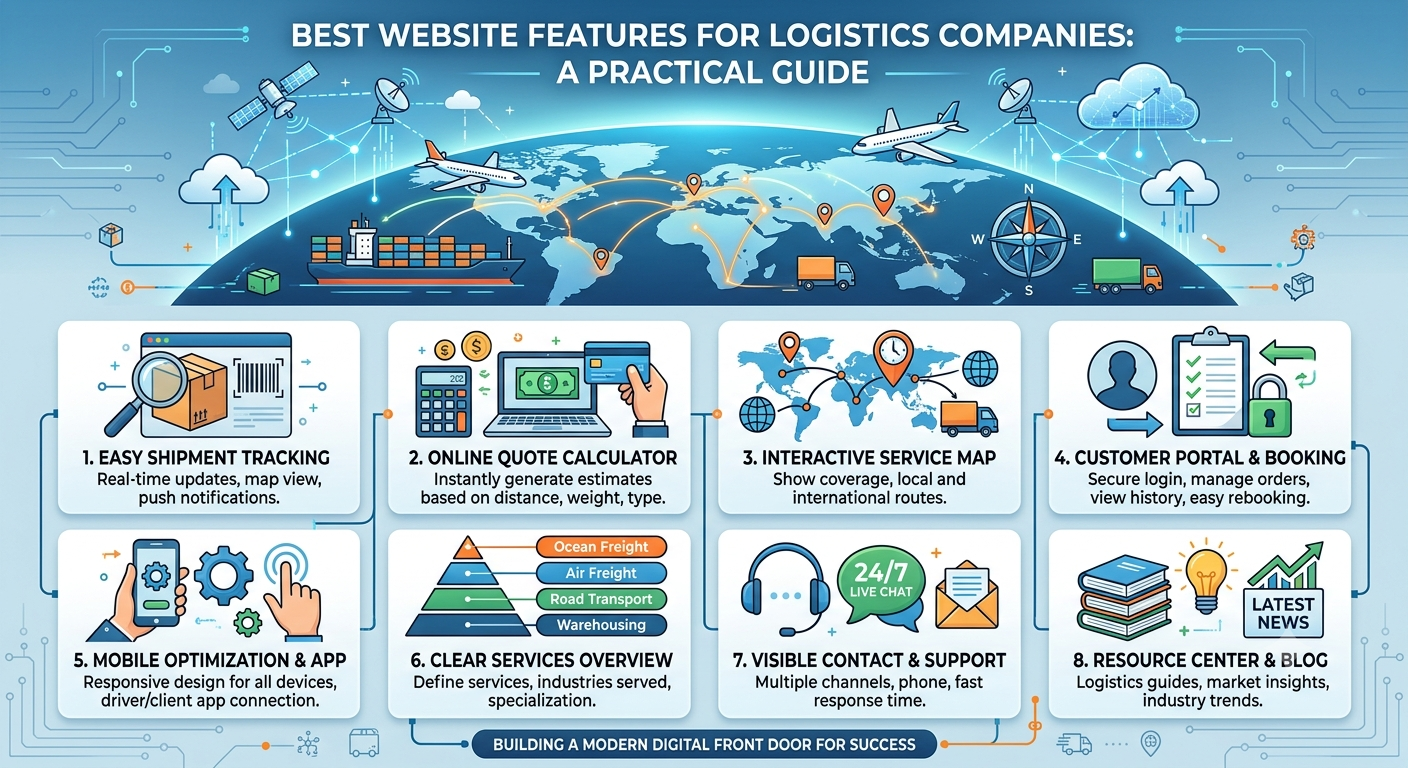
Best Website Features for Logistics Companies: A Practical Guide
If you’re in logistics, you know your customers expect a lot more than just moving stuff from point A to point B. They’re looking for real-time updates, transparency, fast service, and easy ways to get the info they need without hassle.
So, a basic website with your company profile and a phone number really doesn’t cut it anymore.
With the right features, your logistics website can do more than just look good. It can bring in leads, make communication easier, support tracking, boost operations, and build trust often before your sales team even says hello.
No matter if you’re running a transport company, courier service, freight forwarder, warehouse, 3PL, or full-scale supply chain operation, these website features can really set you apart.
20 Essential Features for a Modern Logistics Website
1. A Homepage That Gets to the Point
Visitors shouldn’t need to guess what you do. Your homepage must quickly spell out:
- The logistics services you offer
- Your coverage area
- Industries you serve
- Why you’re different
- Where visitors should go next
Skip the generic lines. Say something clear like: “Reliable Logistics Solutions That Keep Your Business Moving.” Add big, obvious buttons: Get a Quote | Track Shipment | Contact Us.
Nobody should dig around for basic info.
2. Shipment Tracking
This is non-negotiable now. Let customers punch in a tracking or AWB number and see where their shipment is instantly.
Show them the whole journey: Ordered → Picked Up → In Transit → At Hub → Out for Delivery → Delivered. Toss in the current location, delivery ETA, shipment history, delivery attempts, who’s receiving, and proof of delivery.
Give people visibility without making them call you.
3. Online Quote Request
Customers hate calling just to ask, “What’s the price?” Fix that.
Add a Get a Quote form ask only what your sales team actually needs: pickup and delivery locations, package type, size, number of pieces, delivery date, service type, and contact info.
Now your website collects leads, not just fills space.
4. Online Shipment Booking
Why stop at quotes? If you can, let users book shipments online.
A smooth process looks like this: Enter Details → Pick Service → See Price → Confirm Booking → Pay → Get Confirmation.
You’ll cut down busywork and serve people after hours. Even a simple booking request form is a big step up for smaller outfits.
5. Pages for Every Major Service
Don’t dump all services on one page. Create a separate page for each:
- Transportation
- FTL / LTL
- Express / Last-Mile Delivery
- Freight Forwarding
- Warehousing and Distribution
- 3PL, E-commerce Logistics, International Shipping, etc.
On each page, explain what it is, who it’s for, where you offer it, and how to get started. This makes life easier for customers and boosts your site’s SEO.
6. Service Area and Network
Customers need to know, “Do you deliver where I need?” Have a dedicated Service Areas page that lays out:
- Cities, states, and countries you serve
- Warehouses and branch locations
- Key transportation routes
Interactive maps help make sense of big networks. If you serve local areas, dedicated location pages help significantly with local search visibility.
7. Real-Time Notifications
Don’t make customers guess what’s happening. Send updates automatically via WhatsApp, SMS, email, or an account portal.
Cover key milestones like: Booked, Picked Up, Dispatched, Delayed, Out for Delivery, and Delivered.
You’ll cut down on repeated “where’s my shipment?” phone calls dramatically.
8. WhatsApp Integration
Lots of businesses use WhatsApp with customers already. Tie it into your site so people can ask for quotes, check shipments, get support, or talk to sales right away. Make it easy to find, but ensure it doesn't block important content on mobile screens.
9. Login and Dashboard for Customers
If you serve B2B customers, a portal is a huge value-add. Customers can log in to check active shipments, history, tracking, quotes, invoices, reports, and account details. For high-volume clients, this can be a key selling point.
10. Freight Calculator
Let people estimate shipping costs upfront. Ask for the basics: origin, destination, weight, package dimensions, and service speed. Show an instant estimate if you can, or collect the info and alert your sales team if pricing isn’t automated.
11. Industry-Specific Solutions
Don’t act like one size fits all. Manufacturers, e-commerce brands, pharma, retail, and agri-businesses all have different needs. Set up dedicated sections for each, spelling out how you solve their unique challenges. Real-world examples beat vague claims every time.
12. Fleet and Infrastructure Gallery
Show that you’ve got the muscle. Add photos of your actual fleet trucks, vans, warehouses, cold storage, and tech setups. Skip generic stock photos. People trust what they can see.
13. Customer Reviews & Case Studies
Logistics is all about trust. Look beyond simple testimonials show client logos (with permission), case studies, and success stories. Explain what the customer’s problem was, how you solved it, and the quantitative results.
14. Clear Calls to Action (CTAs)
Every important page should direct visitors somewhere useful: Get a Quote, Track Shipment, Book Now, Talk to Sales, Request a Callback, or Partner with Us. Don’t hide your most important actions behind menus.
15. Mobile-First Design
People check shipments on the go, talk to reps, and verify deliveries on their phones. Your forms, tracking bars, menus, and contact info must work seamlessly on any device.
16. SEO-Friendly Structure
A beautiful website is worthless if customers can’t find it. Get the basics right: clean URLs, proper heading structures (H1, H2, H3), unique page titles, meta descriptions, solid internal links, fast loading, and local content.
17. Fast Website Performance
No one wants to wait especially for tracking info. Keep your site quick: compress images, minimize heavy scripts, use reliable hosting/CDNs, and optimize performance continuously.
18. Secure Customer Data
You’re collecting sensitive information shipments, addresses, invoices, and business data. Protect it with HTTPS, strong authentication, role-based access, automated backups, and payment security.
19. FAQ and Knowledge Base
Cut down on repetitive support calls with a solid FAQ section covering tracking, delivery zones, pricing terms, required documents, and delay procedures.
20. Simple Contact and Support
Make it simple to reach a human: phone, email, WhatsApp, physical address, business hours, contact form, map, and support links all organized in one place.
Advanced Features for Enterprise Players
Once you’ve nailed the essential features, consider leveling up with these advanced capabilities:
- Advanced Tracking: Real-time GPS tracking for vehicles and high-value cargo.
- Customer Analytics: Self-serve reports on shipping volume, delivery performance, and spend history.
- API Integration: Connect your site with ERP, CRM, WMS, TMS, or e-commerce platforms like Shopify and WooCommerce.
- Automated Invoicing: Generate and distribute invoices seamlessly upon delivery.
- Online Payments: Allow clients to clear invoices or pay for shipments securely via credit card or digital wallets.
- Driver/Delivery Tools: Mobile workflows for drivers to update status, collect signatures, and capture Proof of Delivery (POD).
Building Around What Matters: The 5-Pillar Framework
Think of a high-performing logistics website built across five distinct operational buckets:
- Attract: Use SEO, valuable content, and location pages to stand out in search results.
- Convert: Use functional quote forms, clear CTAs, and direct communication channels like WhatsApp to convert visitors into leads.
- Serve: Offer tracking tools, customer dashboards, and self-serve documentation.
- Communicate: Keep clients informed through proactive notifications.
- Retain: Deliver smooth user experiences, analytical reports, and reliable service to encourage repeat business.
Final Thoughts
In the end, the best logistics website isn’t the one with the most bells and whistles it’s the one that actually helps people get things done with minimal effort.
Do this, and your website becomes much more than a digital business card it becomes your sales engine, service desk, and a powerful extension of your entire logistics operation.