
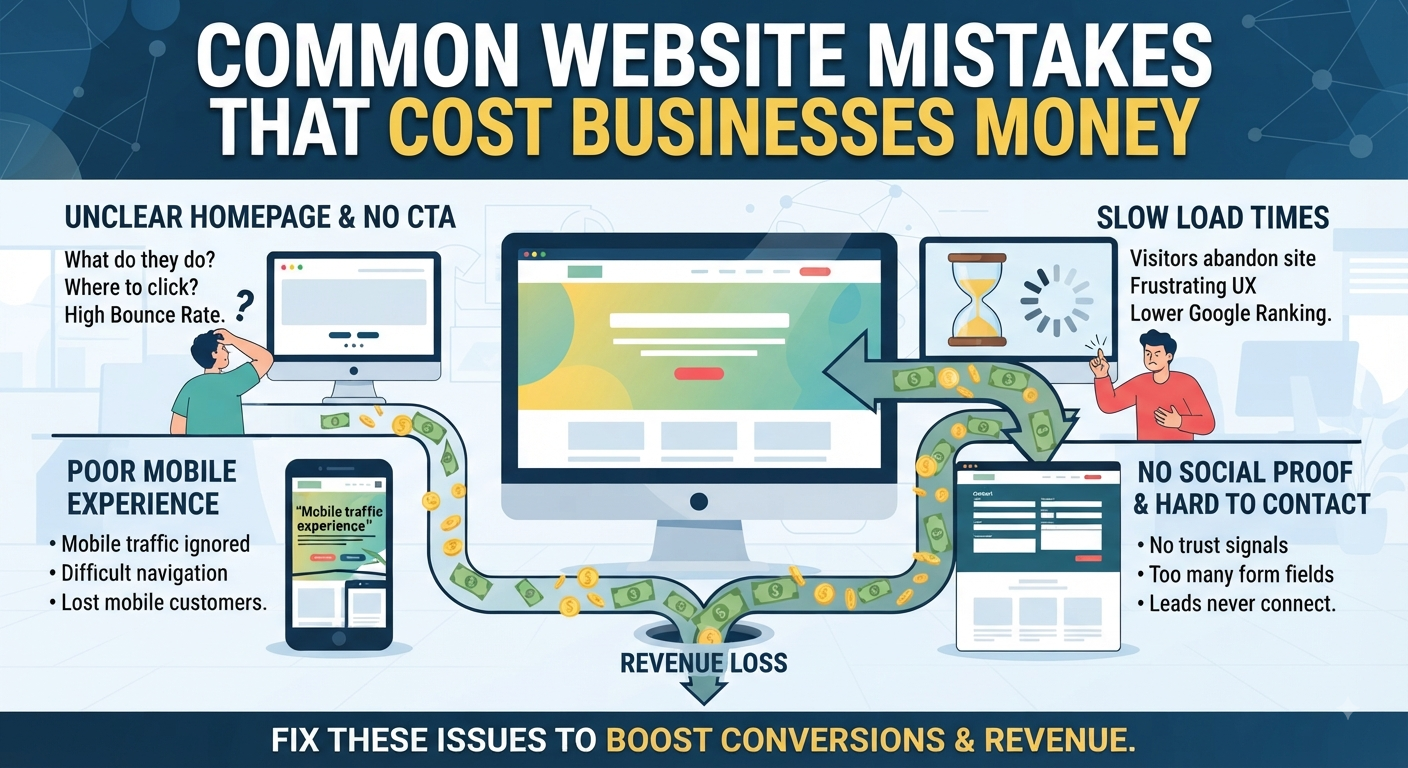
Common Website Mistakes That Cost Businesses Money
These days, having a website isn’t optional. Most customers will visit your website before they call, email, or set foot through your door. They’ll want to know what you do, peek at your work, read some reviews, size you up against competitors, or just find a phone number. That means your website can’t just look pretty it has to actually work for you.
A good website builds trust, brings in leads, supports your sales, and makes it easy for customers to get in touch or buy. The trouble is, a lot of businesses quietly lose money because their websites don’t get the basics right.
Let’s talk about some classic mistakes and how to fix them.
1. Unclear Homepage
When someone lands on your homepage, they should instantly know what you offer. If visitors have to dig through three or four pages just to figure out what your business does, you’ve already lost them. A straight-to-the-point headline, a brief explanation, and a clear invitation to act these matter a lot.
Don’t stick with generic statements like “We create innovative solutions for modern businesses.” Say plainly what you do.
People decide fast. The clearer you are, the better chance they’ll stick around.
2. No Clear Call-to-Action
Maybe someone’s interested, but then what? If there’s no obvious next step “Get a Quote,” “Book a Consultation,” “Buy Now” they’ll lose interest and leave.
Every important page needs a button or link that tells people what to do next. Don’t make them hunt for your contact info or second-guess how to reach you.
3. Slow Website
Everyone’s impatient online. If your site takes too long to load even just a few seconds many visitors will leave before anything appears.
Big images, clunky animations, bloated code, or cheap hosting can all drag things down. Plus, a slow website drops your rankings on Google and makes the user experience miserable.
A slow site isn’t just a tech issue it’s a missed business opportunity.
4. Bad Mobile Experience
A website that looks great on a computer but a mess on a phone yeah, that’s a problem.
These days, most people visit sites on their phones. Menus should work, buttons should be tappable, forms should be easy to fill out even on a tiny screen. If your site’s not mobile-friendly, you’re turning away half (or more) of your customers.
5. Overloading with Information
Some sites throw everything at visitors long paragraphs, endless menus, banners, and pop-ups. It’s overwhelming. Honestly, most people just want answers, not a novel.
Stick to the point. Explain what you do, why it matters, and what someone should do next.
Simple isn’t lazy. It’s smart.
6. Only Talking About Yourself
A lot of websites just list information about the company history, team bios, “our story,” and so on. Customers care more about what you can do for them.
Don’t just say, “We have experienced professionals.” Say how that experience benefits your customer, whether it’s faster service, better results, or stress-free support.
Put yourself in the customer’s shoes and speak to their needs not just your own.
7. Out-of-Date Content
People notice when your site is stale. Picture someone landing on a page with an old offer or a phone number that doesn’t work. Maybe your blog hasn’t had a new post since 2018.
It makes people wonder: Is this business still alive? Review your site often. Keep your services, contact info, prices, team, and images updated.
8. Skipping SEO
Just having a website doesn’t mean people will find it. You need search engine optimization to help Google (and customers) discover you.
Common SEO mistakes: boring titles, weak content, missing headings, bad linking, slow performance, and not matching what people are actually searching for. SEO isn’t a set-it-and-forget-it thing you should think about it from the start.
9. No Social Proof
People want proof that you’ll deliver. Reviews, case studies, testimonials, client logos, certifications, before-and-after projects all these build trust.
Don’t just tell visitors you’re reliable. Show them. Real voices, real stories, real results.
10. Hard to Contact
When someone’s ready to reach out, don’t make them work for it. Your phone, email, WhatsApp, or forms should be dead easy to find. And when you ask someone to fill out a form, keep it short. Every extra field is just another reason to quit.
The easier you make things, the more people will get in touch.
11. Ignoring Website Security
Security matters for you and your customers. Outdated plugins, weak passwords, no backups, missing updates these are open doors for problems.
Stay on top of updates, use secure hosting, back up your site, and use strong logins. Don’t wait for something to go wrong before you care.
12. Not Tracking Performance
How do you know if your website’s working for your business? If you only check traffic, you’re missing the story.
Look at contact form submissions, phone clicks, WhatsApp links, sales, popular pages, and where visitors come from. This tells you what’s working, what’s not, and where to improve.
Good decisions come from actual data, not hunches.
13. Treating the Website as “One and Done”
Launching your site isn’t the finish line. Businesses change. Services evolve. Customers expect more. Competitors step up their game. Technology never stops.
Your website should grow with you. Update your content, review your SEO, run regular security checks, and look for ways to make things smoother. Keep your site alive and in sync with your business.
The Real Price of Website Mistakes
Most website mistakes don’t shout at you. You won’t get a pop-up saying, “You lost a customer because your site was too slow.” Lost sales look like fewer phone calls, a trickle of inquiries, bad search rankings, or wasted ad money. Visitors just slip away, quietly.
You can pour thousands into ads to bring people to your website, but if the site lets you down, much of that money’s wasted.
Final Thought
A website shouldn’t just exist because “everyone needs one.” It should help people find you, understand your value, trust you, and choose you.
You don’t need a flashy site with all the bells and whistles. You need clear writing, a good experience, solid speed, helpful content, proof you’re trustworthy, and a simple way to take action.
Before you spend more on ads, step back and look at your website. Ask yourself: Is this helping my business grow or quietly sending customers away?
A well-built website isn’t just another expense. It’s one of your best salespeople working for you every day.