
From Lead to Client: How to Build a Smarter Agency Sales Process
New leads are exciting they signal someone is interested in what you do but truthfully, that’s just getting warmed up. Where things really get exciting (and often messy) is after those first few steps. One person pulls the inquiry from your website form, another follows up via email, notes get scattered across Slack messages or a Google Sheet, quotes are generated manually, and payment details get lost in transit.
If you’re only managing a handful of inquiries at once, you might get away with this. But as soon as lead volume ramps up, the cracks show: delays, missed follow-ups, redundant data entry, and lost revenue. Streamlining your agency's sales process ensures every inquiry flows seamlessly from first contact to paid invoice.
The Full Agency Sales Workflow
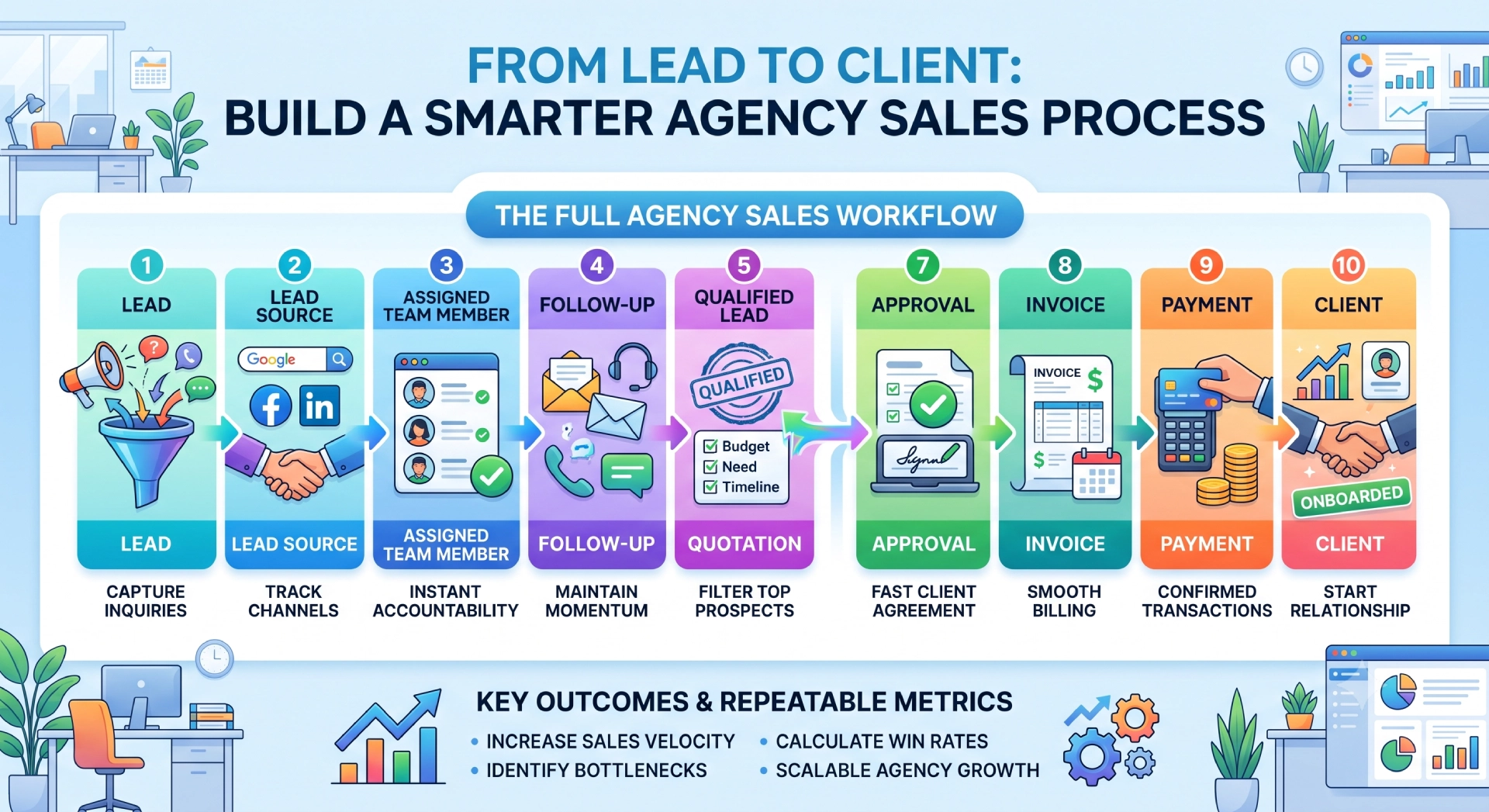
Structuring your sales pipeline ensures nothing falls through the cracks. A high-converting agency workflow connects each stage directly without manual data handoffs:
Lead → Lead Source → Assigned Team Member → Follow-Up → Qualified Lead → Quotation → Approval → Invoice → Payment → Client
The 10-Step Agency Sales Pipeline
1. Lead: Don’t Lose a Single Opportunity
It all starts when someone reaches out via your website, a paid ad, a referral, or cold outreach. Don't let vital contact details get trapped in individual inboxes. Pull all incoming inquiries into a centralized CRM so your team has immediate visibility into who the prospect is, what they need, when they reached out, and what the next step is.
2. Lead Source: Track Where They Come From
Knowing where your leads originate (e.g., organic search, LinkedIn, referrals, paid campaigns) is critical. Tracking source attribution reveals which marketing channels yield the highest return on investment, allowing you to allocate your marketing budget based on real conversion data rather than guesswork.
3. Assigned Team Member: Give Every Lead a Home
Unassigned leads stall out. Route new inquiries to a specific sales rep immediately to create instant accountability. When ownership is clear, your team never has to wonder who is responsible for initiating contact and moving the prospect forward.
4. Follow-Up: Maintain Momentum
Most agency deals require multiple touchpoints, discovery calls, and custom proposals. A unified system maintains a full activity history calls logged, emails sent, meeting notes, and scheduled tasks so your team can pick up conversations without digging through disconnected threads.
5. Qualified Lead: Focus on What Matters
Not every inquiry matches your agency's ideal client profile. Qualify prospects early based on budget, need, decision-making authority, and project timelines. Filtering out bad fits early lets your team direct their energy toward high-value, high-probability opportunities.
6. Quotation: Make Saying “Yes” Easy
Once a lead is qualified, deliver a professional quote or proposal quickly. An integrated pipeline auto-populates project scope, pricing, and client details directly from the CRM record, eliminating duplicate data entry and reducing turnaround time.
7. Approval: Remove the Guesswork
Implement a clear, friction-free approval method such as digital signatures. Integrated approvals instantly trigger the next phase of your pipeline without requiring back-and-forth email confirmations.
8. Invoice: Smooth Out Billing
Quote approval should automatically generate an invoice. Pulling line items and client details directly from the approved estimate prevents administrative errors and speeds up the billing cycle.
9. Payment: Seal the Deal
Connect your payment gateway directly to your invoicing workflow. Real-time payment tracking gives your team instant visibility into outstanding balances, paid accounts, and active client conversions.
10. Client: Start the Relationship
Receiving payment marks the transition from sales to client delivery. Hand off all historical CRM context, project scope notes, and expectations directly to the account and project management teams so the client never has to repeat themselves during onboarding.
Make the Process Repeatable
A scalable agency does not rely on individual memory; it relies on predictable systems. To keep your pipeline healthy, track these core metrics regularly:
- Volume: New inbound inquiries per day, week, and month.
- Attribution: Top-performing acquisition channels.
- Ownership: Active lead distribution across sales reps.
- Pipeline Velocity: Average response time and pending follow-ups.
- Conversion Rates: Proposal-to-approval ratios and win rates.
- Revenue: Invoiced amounts versus collected payments.
Fix the Process, Don't Just Add Tools
The solution to pipeline friction isn't adopting more disconnected software. It is building a unified workflow where data moves automatically from step to step. When administrative overhead drops, your team spends less time copying data across spreadsheets and more time closing high-value accounts.