
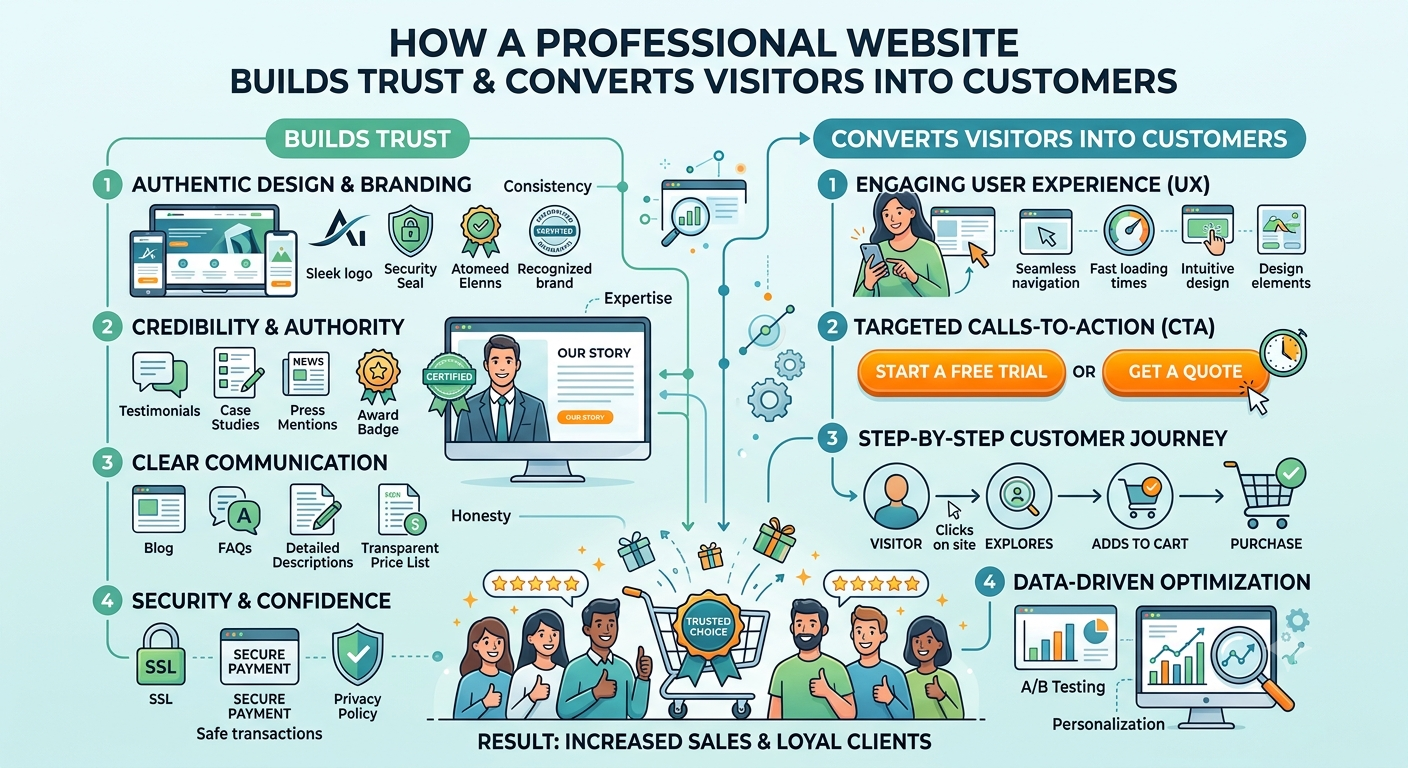
How a Professional Website Builds Trust & Converts Visitors into Customers
Most people never meet you before deciding to buy. They probably won’t talk to your sales team or stop by your office. Heck, they might not even call. Usually, they’ll just look you up online and land on your website.
Right there, in those first few seconds, they’re sizing you up and quietly asking, “Can I trust this company?” That question matters more than most business owners think.
A professional website does much more than list your services it gives people confidence that you’re legit, experienced, reliable, and that you’ll actually deliver. In a way, your website doesn’t just represent your business; it’s a part of your reputation.
Your Website Is Your First Impression
Think about the last time you found a business online. Before you ever picked up the phone, you probably browsed their site, checked out what they do, skimmed some testimonials, maybe googled a few reviews basically, you were trying to figure out if you could trust them.
Your customers do the same thing.
If your website looks sharp, easy to use, and up-to-date, people get a good vibe right away. But an outdated or sloppy site? It’s a red flag.
Honestly, you don’t need fancy graphics or wild animations to impress. Just make your site:
- Clean and simple to use
- Consistent in style
- Mobile-friendly
- Fast to load
- Free from mistakes
- Clear about your services
- Easy to contact
When your website checks these boxes, it quietly reassures people. Reducing doubt is the first step toward building trust.
Trust Starts With Clarity
People want to do business with companies they understand. If someone lands on your homepage and has to work to figure out what you do, they’re gone.
Make your homepage answer this right away: “What can this business do for me?”
Describe your services in plain English. List products with clear, accurate info. And never make customers hunt for your contact details.
Skip the jargon and empty buzzwords. Nobody was ever sold on, “We deliver innovative, next-generation solutions designed to empower businesses.” Tell people what you actually do, and spell out how it helps them.
Clarity feels honest. Honesty builds trust.
Back Up What You Say
Let’s be real, every business says, “We’re the best,” “We care about our customers,” and “We deliver quality.” People have heard it all before.
So, why should they believe you?
Show them. Share real examples of your work. Feature reviews from actual customers. Post case studies. Mention certifications or awards. Explain your experience.
If you’re a web developer, don’t just say you build great sites show real projects, walk people through problems you solved, and share results. This is social proof, and nothing beats it.
People naturally feel better choosing a company others have trusted.
Show Your Business Is Real
Want to seem credible? Give people a peek behind the curtain.
Your website should show who’s behind the business. A solid About page might include your story, team members, office location, your mission, and any big wins or industries you serve.
Don’t write a novel just enough so people know there are actual humans and real expertise behind the scenes.
A little transparency goes a long way.
Details Matter
Trust doesn’t happen because of one big thing. It’s lots of little things working together.
People notice if:
- Your website has no typos
- The images aren’t blurry
- All buttons and links work
- Pages load fast
- Contact info is right there
- The mobile version isn’t broken
- Prices and service info are clear
- Forms are quick to fill out
- Branding is consistent
No single detail may seem critical, but put together, they say, “We care about quality.” If you care about your website, people naturally think you’ll care about their business too.
Security Makes Customers Feel Safe
Picture this: you’re about to enter your credit card info and the site looks shady or outdated. You’d bail, wouldn’t you?
Security isn’t just for your IT team it’s part of your customer experience. Use HTTPS. Protect forms. Run updates. Use secure payments. Set clear privacy policies.
Most people won’t know all the tech stuff, but they can sense when something feels off.
Mobile Experience Is Everything
People find your business from their couch, on a train, during a coffee break, or wherever. They’re probably using a phone.
If your site looks great on a laptop but is a pain on a phone, you’re losing trust and customers.
Your site needs to adjust to any screen. Text should stay readable. Navigation should stay easy. Buttons should work. Forms shouldn’t be a hassle.
A smooth mobile experience tells people you get how they use the web.
Speed Really Does Matter
A beautiful website isn’t much good if it loads at a snail’s pace. Slow sites annoy people and make you look unprofessional.
Things like giant images, useless scripts, cheap hosting, or clunky plugins can all slow you down.
Design your site to be fast from day one. Quick page loads mean less frustration and a better experience. Speed isn’t just technical people judge your brand by it.
Help Before You Sell
One of the strongest ways to build trust online: be genuinely helpful.
Don’t just pitch your products answer the questions customers are already asking. Things like:
- What’s included with this service?
- How much does it cost?
- How long does it take?
- What should people bring or prepare?
- What pitfalls should they avoid?
- How can they pick the right solution?
A blog packed with real answers is powerful. When people keep finding helpful info from you, they remember you. When they’re ready to buy, you’re at the top of their mind.
Being helpful builds familiarity. Familiarity becomes trust. Trust brings business.
Make Contact Simple
Trust vanishes if people can’t figure out how to reach you.
Your phone number, email, WhatsApp, contact form, and location should all be easy to spot. Don’t make people dig for it.
Guide visitors to the next step whether it’s “Call Now,” “Request a Quote,” “Book a Call,” “Buy Now,” or “Send an Enquiry.”
The specifics depend on your business, but the rule stands: never make people guess what to do next.
Be Open and Transparent
When it comes to money, personal info, or major decisions, people are cautious. Clear policies help calm their nerves.
Depending on what you do, you might need pages for:
- Privacy Policy
- Terms and Conditions
- Refund/Cancellation Policy
- Shipping Policy
- Disclaimer
- Cookie Policy
These aren’t glamorous, but they show your business plays fair. Transparency builds confidence.
A Professional Website Does More Than Look Good
People often think a website’s all about pretty colors and flashy animations. Those help, but a true professional site does so much more.
It answers questions. Clears up doubts. Shows your expertise. Proves your worth. Protects customer info. Makes talking to you easy. Most of all, it gives people a reason to trust you.
Your Website Works While You Sleep
Your sales team can’t talk to everyone at once. Your website never stops.
At any hour, someone can land on your site and learn about you, see your work, and decide to reach out. It’s more than a digital business card it’s a tireless business asset.
The Real Value of a Professional Website
It’s not just that your site looks great. The real magic is in what visitors feel and do.
A good website makes someone think:
“This company looks sharp.”
“They know their stuff.”
“Others trust them.”
And finally, “I feel good reaching out.”
That’s how you turn clicks into customers.
Final Thoughts
You don’t earn trust with a slick homepage or a single testimonial. Trust comes from consistency: a site that looks professional, content that’s clear, info that’s real, functions that work, and policies that don’t hide anything.
Every interaction should leave people more confident, not more confused.
In a crowded market, people have endless options. They’ll pick the business that gives them enough confidence to take the next step.
Your website is your shot to create that confidence before you ever say a word. A professional site doesn’t just say, “Trust us" it gives people real reasons to believe you.