Why CRM Alone Isn't Enough for Digital Agencies | Operations Guide
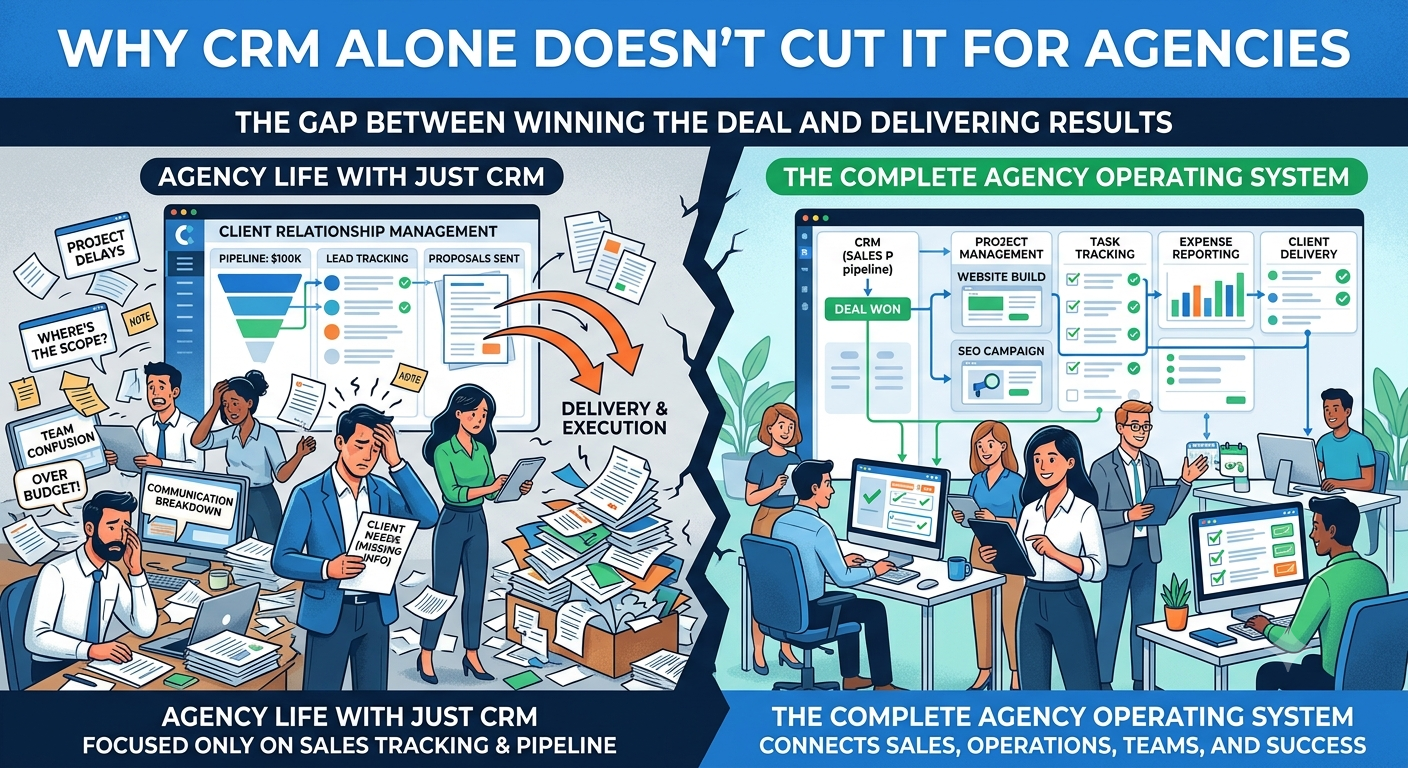
A CRM can help you spot your next client. That’s great but honestly, that’s just the start. It can’t tell you what your team needs to deliver. Or who’s handling which piece. Or how much the project’s actually costing you. Or whether you’ll hit the deadline.
And that’s a big deal.
Winning a client isn’t the agency’s grand finale. It’s just the moment when a whole new process kicks in delivery.
That’s why agencies eventually outgrow the “just a CRM” setup.
A CRM Tackles Sales. Agencies Face More Than Just Sales.
CRMs are built for the front end. They capture leads, track prospects, remind you to follow up, and let you see who’s at what stage.
You get a clear view of:
- New leads
- People you’ve already reached out to
- Serious opportunities
- Pending proposals
- Lost or won deals
Helpful, no doubt.
But then, the deal closes.
And now what?
- Where does the project details go?
- Who’s creating the tasks?
- Who’s assigning them?
- Which services did the client actually buy?
- What deadline are you staring at?
- Which expenses keep popping up?
- What’s wrapped up and what’s still hanging?
That’s the moment you realize: The CRM has left the chat.
Because selling is only one part of running an agency.
“Deal Won” Isn’t Where The Work Stops
One of the classic mistakes agencies make? Thinking that once the sales pipeline runs smoothly, they’re set.
The reality is, right after marking a deal “won,” the info starts drifting.
Suddenly, a salesperson is texting project details over WhatsApp. Someone else is punching tasks into Trello. The designer is getting notes in Slack. The project manager’s juggling a spreadsheet. Expenses appear in yet another place. Client emails are scattered in the inbox. The owner’s piecing it all together with constant check-ins.
So yes, you may have a CRM. But that’s not really an operating system it’s just one part.
What Agencies Really Need
Managing relationships is only the beginning. You’re actually managing a full operational chain:
Lead → Client → Service → Project → Tasks → Expenses → Delivery
Everything connects:
- A lead turns into a client.
- A client buys one or more services.
- That kicks off delivery.
- Which becomes projects and tasks.
- Projects suck up time and money.
- And tasks keep things moving (or not).
All leading to one thing: getting the work done for your client.
If your system’s only handling the first two stages, you’re running a sales machine not a real agency.
1. CRM: Track Opportunities
Your CRM’s main question is: “Who could become our next client?”
It keeps tabs on leads, prospects, follow-ups, pipeline stages, proposals, conversions all the stuff that gets the ball rolling. But once the conversation becomes a real client? That data shouldn’t just disappear into the ether. It should roll right into delivery, seamlessly.
2. Clients & Services: Know What You Sold
Clients aren’t just lines in your contact list. They bought something for a reason. Could be:
- A new website
- SEO
- Social media management
- Design
- Maintenance
- Advertising
- Data services
Your system needs to track exactly what got sold. This is your bridge from sales to operations. The delivery team shouldn’t have to chase down the sales team to know what was promised the system should already have the answer.
3. Projects: Turn Sales Into Work
Signed deals need to become real projects with all the details to get things moving:
- Which client
- What service
- The scope
- Timeline
- Who’s on the team
- Status
- Deadlines
- Deliverables
Your CRM says, “We landed them.” Your project tool says, “Here’s what we need to do.”
4. Tasks: Break Projects Into Action
Projects don’t finish themselves people do.
Building a website, for example, could mean: Content → Design → Dev → Testing → Review → Revisions → Launch
Each step lands on different people’s plates. Without a solid task system, stuff gets lost in chats and sticky notes. Suddenly the project’s relying on memory, reminders, and luck. A good management system keeps it all clear: who’s doing what, what’s next, and what’s done.
5. Expenses: Know Your Real Costs
Revenue shows how much your client paid. Expenses reveal what it truly cost to deliver. That gap is everything.
Freelancers, subscriptions, ad spend, outside vendors, production costs they all eat at your margin. If you’re not watching expenses at the project or service level, you’re flying blind. A ₹1 lakh project isn’t really a ₹1 lakh win until you know the actual profit.
6. Delivery: Where Your Agency Shines
This is what clients pay for the work itself. Not the CRM, not the proposal, definitely not just the pipeline.
True delivery is knowing:
- What got sold
- Who’s working on what
- What’s delayed
- What’s done
- What still needs attention
Management becomes manageable. The team knows what’s up. Clients get better service. The owner isn’t living in Slack or endlessly polling the team for updates.
The Real Issue: Everything’s Scattered
Most agencies already use a pile of tools. That’s not the problem.
The real headache is that everything’s spread out one tool for leads, another for projects, a different one for tasks, a spreadsheet for expenses, client data somewhere else, WhatsApp for chitchat, email for approvals, a random document for anything that doesn’t fit.
Each tool works solo, but nobody’s talking to each other. That’s where messes happen. The handoff between tools is where things get lost, delayed, or misread.
From CRM to Agency Operating System
You probably don’t need another app. What you need is a system one where everything connects.
Picture this workflow:
- A lead lands in the CRM.
- The team qualifies them.
- You send a quote.
- The client says yes.
- That quote launches a new client record with all the right services assigned.
- A project gets created automatically.
- Tasks flow straight to the right team members.
- Expenses are tracked instantly.
- Progress updates make their way back for management to see.
- The whole job, start to finish, is connected.
No copying and pasting. No chasing random texts or emails. No asking five people for the same info. Just one clean workflow.
Agencies Need an Operating System Not Just a CRM
The CRM is your sales backbone.
But agencies are complex creatures. What they need is everything connected:
Sales + Clients + Services + Projects + Tasks + Expenses + Delivery
Let these run independently and you spend all day moving data around and following up. Bring them together, and suddenly you can focus on the business, not just the busywork. That’s the big difference between a CRM and a real agency operating system.
A CRM helps you answer: “Who’s our next client?”
An agency system lets you ask the bigger question: “How do we keep things running smoothly, start to finish?”
If you’re building a growing agency, that difference decides whether you scale or stall. Bringing in the client is just the start. Real success is everything that happens after you win the deal.
Connect your sales and delivery into one system and turn your agency into something bigger, smoother, and a whole lot more organized.