
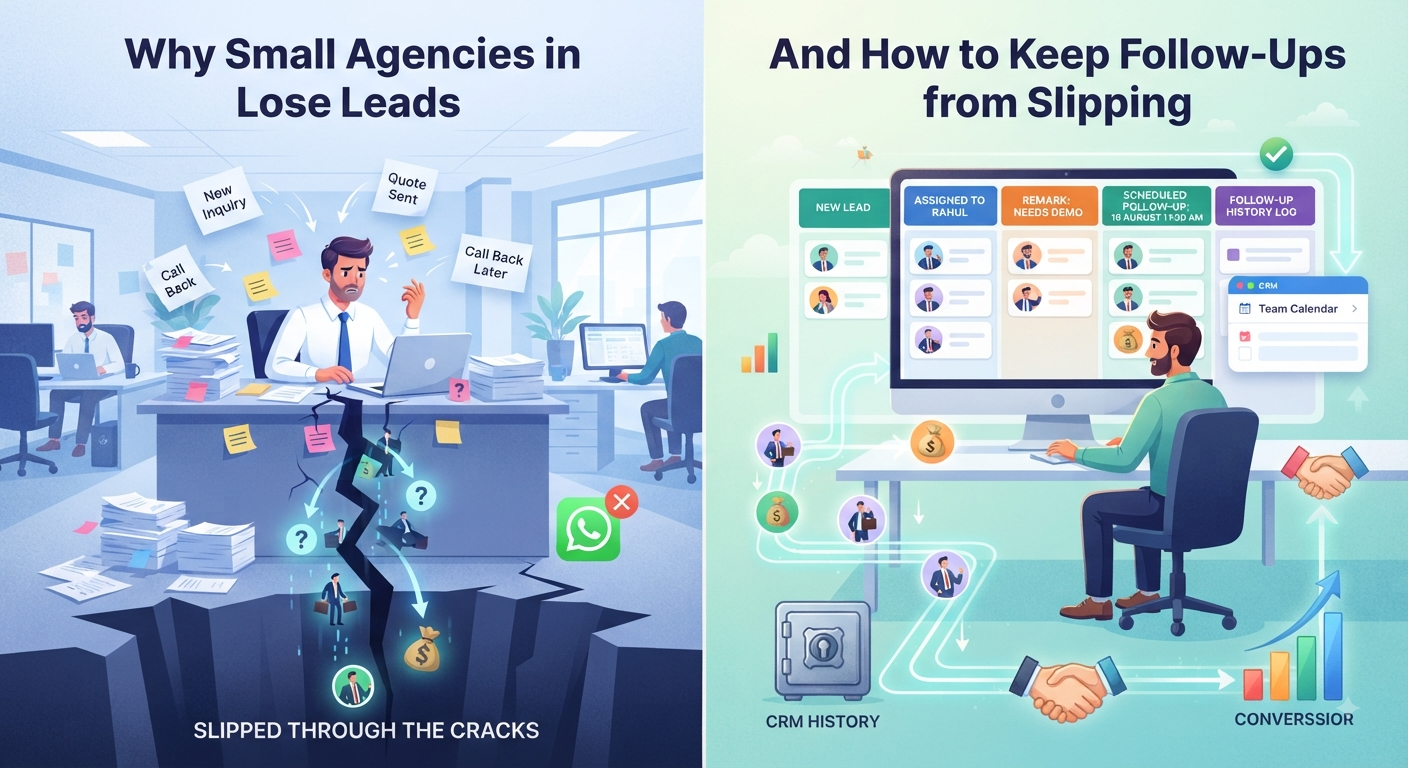
Why Small Agencies Lose Leads (And How to Fix Your Follow-Up Process)
We’ve all been there. A new lead pops in. Someone pipes up with, “I’ll call them back.” And then the day blows up.
Suddenly, you’re chasing an urgent client update. There’s a deadline staring you down. Somebody else needs a quote. A couple more enquiries show up, just for good measure.
Meanwhile, that callback just keeps getting bumped first to tomorrow, then next week and when someone finally remembers, the prospect’s already picked another agency.
Honestly, this happens a lot more often than most small agencies want to admit.
The real issue isn’t always a shortage of leads. Sometimes, good leads just fall through the cracks. With no clear system for follow-ups, solid opportunities vanish with barely a sound.
Counting the Real Cost of Missed Follow-Ups
Picture it: a prospect reaches out about a ₹75,000 website project. The call feels good. They seem interested and, naturally, ask for a quote.
Your team sends the quote off.
Now, the next move is obvious: follow up.
And yet…no one jot downs when they’ll call back.
A couple days slip by.
Then a week.
By the time you think to check in, the client’s signed with someone else.
You start looking at your pipeline and think, “We just need more leads.”
But the truth is, maybe you didn’t. Maybe you just needed to finish what you started. That’s where a lot of small agencies let revenue walk right out the door.
Who Actually Owns the Lead?
A fresh enquiry comes in.
The sales manager spots it.
A team member notices, too.
Somebody forwards it on WhatsApp.
And everyone just assumes someone else is handling it.
Here’s where things start to derail.
Every lead needs one clear owner. One person should always know they’re responsible for calling, figuring out what the prospect needs, and making the next move.
For example:
New Lead → Assigned to Rahul → Rahul’s job to follow up
Making things this clear means there’s no finger-pointing, no confused, “Hey, weren’t you supposed to call them?”and no leads gathering dust in the inbox.
“I’ll Call Them Later” Isn’t a System
Here’s one of the most dangerous lines in sales: “I’ll call them later.”
We all get busy. Even the best salespeople forget when three things land at once. This doesn’t mean they aren’t committed it just means no one’s memory is foolproof.
Don’t wing it. Log the next action clearly.
For example:
- Next Follow-Up: 19 August
- Time: 11:30 AM
- Action: Call to discuss the website quote
Now, the callback isn’t floating around in someone’s head; it’s part of how you actually work.
A Lead with No Next Step Is Already Fading Away
Your CRM should answer one basic question every time: “What happens next?”
If no one can say, that lead’s as good as dead.
Just look at these two notes:
Lead A:
“Spoke with the client. Interested in the proposal. Call again on Friday to discuss pricing.”
Lead B:
“Client interested.”
Which one makes it easier to act? Obviously, Lead A. Details matter they tell people exactly where things stand and what to do next. That’s how you turn a casual note into a real sales conversation.
Don’t Let Important Conversations Get Lost in WhatsApp
WhatsApp is great for chatting. But if you treat it like your lead management system, things get messy.
When info is scattered across group chats, notebooks, and memory, you lose track of what really happened. Then people start asking, “Did we send that quote?” or “What did the client say about the price?” or “When did we last speak?”
If nobody knows, everyone wastes time piecing things together.
A proper follow-up history stops all that.
Example:
- 12 Aug: Initial enquiry received
- 13 Aug: Talked through requirements
- 14 Aug: Sent out the quote
- 16 Aug: Client asked about pricing
- 19 Aug: Follow-up scheduled
With this trail, anyone can quickly catch up on what’s been done.
Follow-Up History Is Your Safety Net
Sure, your salesperson remembers what happened this week. How about six months from now? Or when another team member steps in, or if the original person’s sick or leaves?
If there’s no record, everything starts from scratch and the conversation falls apart.
With a history? The agency can pick up right where things left off. The lead always belongs to the business, not a single salesperson a big deal as your team starts to grow.
A Simple Workflow That Works
You don’t need a fancy, complicated process. Just a simple, repeatable system, for example:
Lead
Capture the basics.
↓
Assigned Team Member
Make sure someone owns it.
↓
Remark
Log what happened last.
↓
Next Follow-Up
Write down the next step.
↓
Follow-Up History
Keep track of all calls, updates, and quotes.
Simple as that.
Lead → Assigned Team Member → Remark → Next Follow-Up → Follow-Up History
Easy for a small team, and enough structure to keep opportunities from fading away.
What Changes When You Nail This Process?
You get a lot more than just a few extra callbacks.
- Accountability: There’s never confusion about who’s handling what.
- Speed: New enquiries get action, not neglect.
- Fewer missed deals: Scheduled follow-ups mean you don’t forget.
- Better conversations: Notes help sellers jump back in with context.
- Smooth teamwork: Anyone can step in without digging around.
- Visibility: You actually see which leads are moving forward and which aren’t.
Most important? The whole sales process becomes something you can repeat and rely on.
Maybe You Don’t Actually Need More Leads
Before you pour more money into advertising, pause for a second.
Ask, “Are we even following up the right way?”
- How many leads just sit around with no owner?
- How many don’t have a next follow-up date?
- How many got a call once, then nothing?
- How much important info is buried in WhatsApp, forgotten?
- How many prospects got a quote, but never got a callback?
These aren’t just admin headaches they’re places you’re leaking revenue.
Stop Letting Follow-Ups Be a Memory Game
Running a small agency is already chaotic enough. You shouldn’t have to bank on your memory (or your team’s) to know who needs a call.
A good CRM workflow gives every lead a clear path:
Lead → Assigned Team Member → Remark → Next Follow-Up → Follow-Up History
- Every lead has someone in charge.
- Every conversation has notes.
- Every live opportunity has a next action.
- And every important moment gets recorded.
That’s how you move from, “I think someone’s got it,” to knowing exactly what’s next no guessing.
Bottom Line
Leads are worth something only if you actually follow up.
You don’t need a sprawling, high-tech sales machine. You need a reliable, simple system so the right person knows what to do, when to do it, and what’s already happened.
Don’t let your best opportunities slip away just because someone forgot. Put a real process in place, and watch how much further your leads actually take you.