
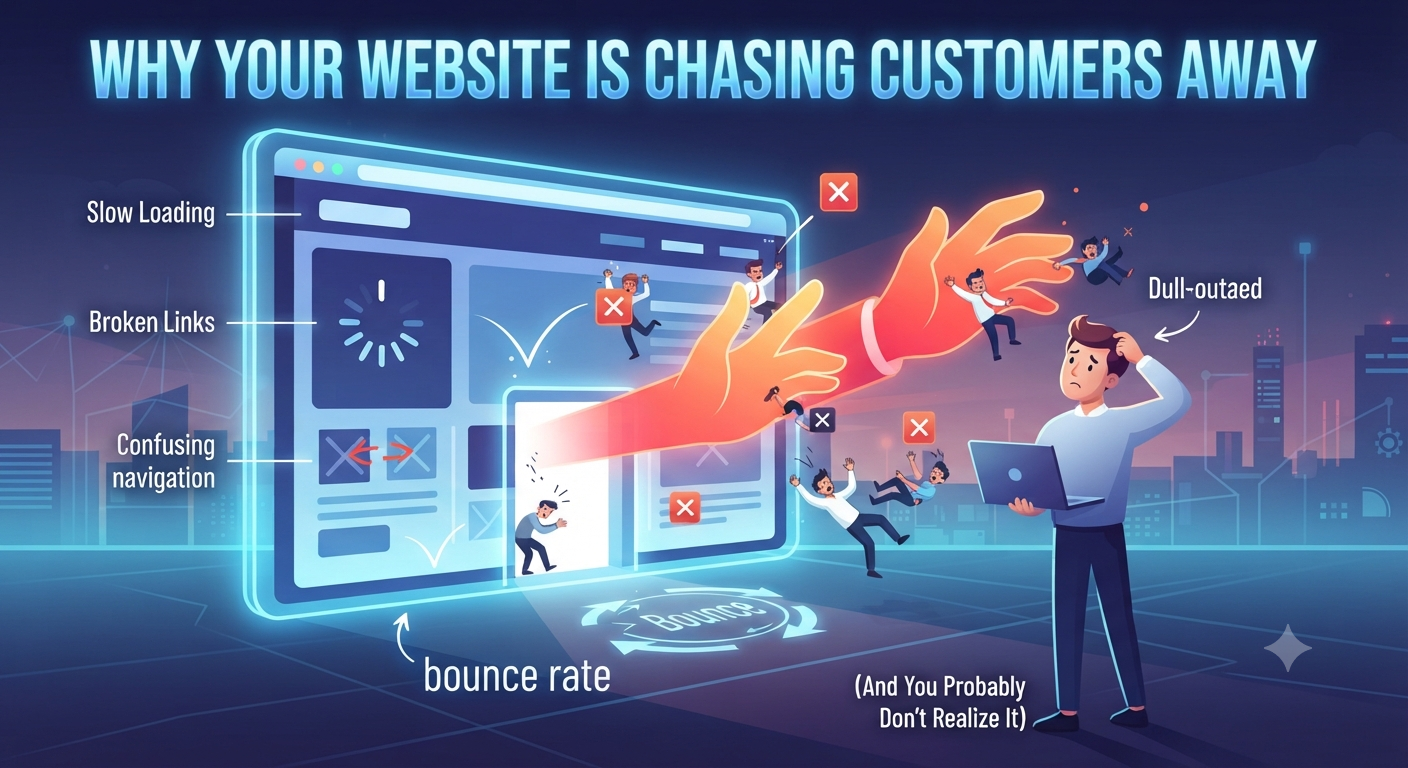
Why Your Website Is Chasing Customers Away & How to Fix It
Picture this: You walk into a store, and the lights are too dim, the aisles are messy, nobody greets you, and it takes forever just to find what you need. You wouldn’t stick around, right? Now, think about your website.
For most people, your website is the very first handshake with your business. If it’s slow, confusing, outdated, or feels sketchy, people bounce fast. And chances are, they’re checking out your competitors next.
Honestly, it’s not usually a bad product or lousy service that sends customers running. They leave because your website just doesn’t make a good first impression.
So, what’s going wrong? Let’s get blunt about it.
1. Your Website Loads at a Snail’s Pace
Nobody is waiting for your site to load. Three seconds feels like an eternity online. Visitors get frustrated, disappear, and Google even drops your rankings, making it even tougher for new people to find you.
How to Speed Things Up:
- Shrink your images.
- Pick a solid hosting provider.
- Get rid of all those unnecessary plugins and scripts.
- Use browser caching and a CDN.
Speed matters it keeps people from walking out the (virtual) door.
2. Your Homepage Doesn’t Say What You Actually Do
Too many websites go for “wow” when they should be clear. When someone lands on your home page, they should instantly know:
- What you offer.
- Who it’s for.
- Why they should choose you.
Don’t make them hunt for answers. If it’s a mystery, most people won’t stick around to solve it. Remember: Clear always beats clever.
3. You’re Not Building Trust
People buy from businesses they trust that’s just the truth. If your website doesn’t look credible, expect hesitation.
Ask yourself:
- Are you showing off customer reviews?
- Got testimonials?
- Any real-life projects highlighted?
- Is your site secure (that little lock in the browser)?
- Is all your contact info easy to find?
Trust comes from proof, not promises.
4. Your Design Is Stuck in the Past
Web design changes all the time. If your site looks like it hasn’t been touched in years, you’re sending the wrong message: “If they don’t even care how they look online, will they care about me as a customer?” You could offer world-class service, but if your site feels ancient, you’ll still lose credibility. Clean, modern design builds instant confidence.
5. Your Website Isn’t Mobile-Friendly
Let’s be real most people are on their phones. If your site’s hard to use on a small screen think zooming, awkward buttons, endless scrolling people just leave. A good website adapts to any device and keeps everything smooth. By now (2026!), if your site isn’t mobile-friendly, you’re waving goodbye to a ton of potential customers.
6. Visitors Have No Idea What to Do Next
It’s like having a salesperson who never actually asks for the sale. Every crucial page should point to a next step. Make it obvious:
- Get a Free Quote
- Book a Call
- Schedule a Demo
- Contact Our Team
If you don’t nudge them, people won’t act. It’s that simple.
7. Finding Info Feels Like a Scavenger Hunt
No one’s got patience to dig through endless menus or convoluted links. A confusing website means people get annoyed and leave. The best sites let people find what they need in seconds. Make navigation stupidly simple.
8. Your Content Is All About You, Not the Customer
How many websites start with “We’re a leading company with decades of experience…” Does anyone care? Visitors want to know, “How are you going to help me?” So flip the script: Talk about the problems you solve, the results you deliver, and how you make life better for your customers.
9. Reaching You Is a Chore
Let’s say somebody does want to contact you. Great! But if your form looks like a tax return, forget it. The easier you make it, the more people get in touch.
What to include:
- Phone number
- Simple contact form
- Location (if needed)
Don’t make it hard for people who already want to talk to you.
10. Your Site Hides From Google
A gorgeous site that doesn’t show up in search? It’s invisible. SEO isn’t just for techies; it’s what gets you found.
You need:
- Pages with the right keywords
- Fast loading speed
- Mobile-friendly design
- Useful blog posts
- Good internal links
- Tech optimization
SEO means the right people actually find your business not just any traffic, but people who want what you’re offering.
11. Your Website Is Just a Digital Brochure
A lot of businesses treat their site like an old-school flyer and just hope for emails. These days, your website should do so much more. It should educate, build trust, answer real questions, capture leads, and bring in sales sometimes while you’re getting your eight hours.
Your website should be your best salesperson, working nonstop.
The Real Cost of a Bad Website
When sales drop, it’s obvious. What’s not obvious is all those people who almost became customers but left without a word. Every clunky page, awkward layout, missing review, or unclear message? That’s money walking out the door.
The good part: these are all fixable. Make your website faster, clearer, more trustworthy, and you’ll see the difference. Suddenly, more visitors stick around and actually become customers.
In the End…
Your website is more than an online business card. It’s your digital storefront, your main marketing engine, and the first real impression people get.
If it loads slow, confuses people, skips on building trust, or doesn’t guide folks to take action, you’re losing customers. And you’ll never even know they were there.
A strong website doesn’t just attract visits. It earns trust, starts conversations, lands leads, and fuels steady growth.
So don’t just wonder if you need a better site ask yourself: How many customers do I lose every single day because my website’s just not doing its job?
That question alone ought to change the way you look at your online presence.