
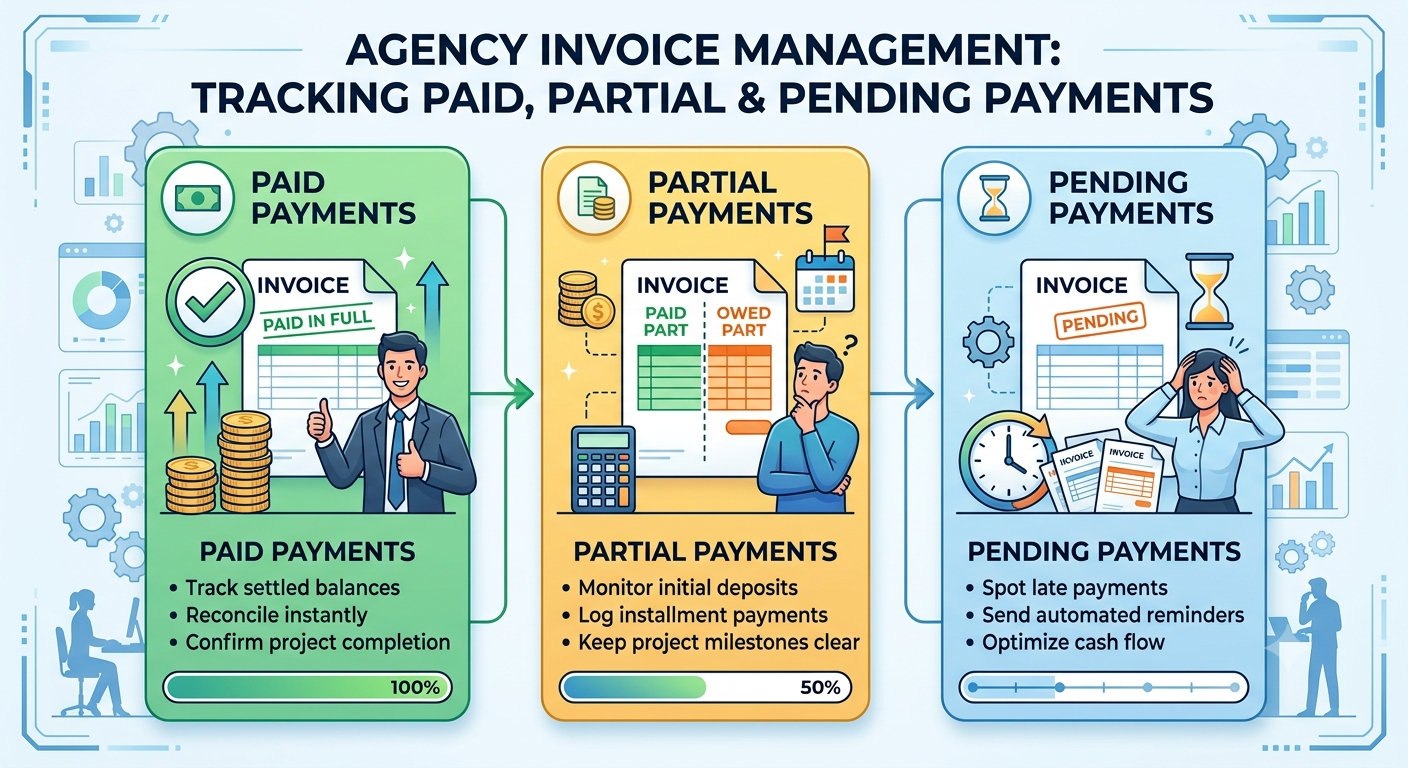
Agency Invoice Management: Track Paid, Partial & Unpaid Fees
Managing invoices isn’t just about sending out a document and waiting for the money. For agencies, every invoice is a piece of the bigger financial picture you want to know exactly what’s billed, what’s been received, and what’s still hanging out there, waiting to be collected. If you’re juggling spreadsheets, emails, screenshots, and manual updates, sooner or later you’ll lose track. It happens. Suddenly you’re not sure who’s paid, who’s made a partial payment, or which payments are overdue.
A solid invoice management system changes all that. It gives you a clear read on your finances and makes chasing payments less stressful.
Why Invoice Management Matters for Agencies
Agencies rarely deal with just one project or one payment structure. Clients pay in all sorts of ways some send everything upfront, others split payments, and a few take their time clearing invoices. If you don’t have a structured system, your team’s stuck digging through emails and files to answer:
- Which invoices are paid?
- Who’s made a partial payment?
- What’s still pending?
- When did the last payment come in?
- Who needs a follow-up?
- What’s the actual cash collected?
A good management workflow answers these instantly, no manual math every time.
1. Make Professional Invoices Easily
Start with accuracy. Don't mess around with Word docs or Excel sheets unless you have to. Reliable software pulls together client info, services, prices, taxes, discounts, and totals all in one place. Less chance for mistakes wrong totals, missing info, duplicate numbers. When the invoice’s ready, it’s not just another PDF in a folder; it’s part of your agency’s payment record.
2. Automatically Send Invoices
Making the invoice is just step one. It has to get to the client. With automatic email delivery, you hit send and the invoice lands in their inbox, complete with payment details. No need to attach files manually or write emails from scratch every time. You build a routine and your communication stays consistent.
3. Let Clients Download Their Invoices
Clients need invoices for their books, approvals, taxes, or just to process payments. Give them an easy way to download what they need. No more “Can you resend that invoice?” pinging your inbox. A simple feature, but it saves your team tons of back-and-forth.
4. Connect Invoices to Online Payments
Most agencies expect clients to pay online now. Hook your invoices up to a payment gateway, and clients pay right there. It keeps payments tied to the right invoice, and your team always knows where the money came from. So the whole process flows:
Invoice made → Invoice sent → Client pays → Transaction recorded → Balance updated
Fewer manual checks, better visibility.
5. Track Partial Payments Without Confusion
Partial payments happen all the time. Say you collect an advance before a project starts, then the rest at the end. You need to know exactly what's left.
For example:
- Invoice: ₹50,000
- Paid: ₹20,000
- Pending: ₹30,000
Don't mark it as paid just because money came in. The system should clearly show it as “Partially Paid” your team knows where things stand, no confusion.
Example Scenario:
An agency bills ₹50,000 for a project. The client pays ₹20,000 upfront. The invoice displays:
- Total: ₹50,000
- Paid: ₹20,000
- Pending: ₹30,000
- Status: Partially Paid
When ₹30,000 arrives, it switches to “Fully Paid.” So much easier than juggling multiple spreadsheets.
6. See What’s Still Pending
Pending payments are a big deal. Just because you’ve billed for something doesn’t mean it’s money in the bank. That makes a difference:
If you’ve invoiced ₹5,00,000 but only collected ₹3,50,000, you’ve got ₹1,50,000 still out there. A proper system shows this immediately:
Total Billed → Total Received → Total Pending
It’s straight-up transparency what you have, what you’re waiting for.
7. Mark Invoices as Fully Paid Automatically
Once the payment matches the invoice, it should switch to “Fully Paid.” No manual updates, no extra clicks.
- Invoice Total: ₹50,000
- First Payment: ₹20,000
- Second Payment: ₹30,000
- Total Received: ₹50,000
- Pending: ₹0
- Status: Fully Paid
Simple, right? The system shows the real status, always.
8. Map Transactions to Invoices
You want every payment linked to its invoice. When you see a ₹20,000 bank transaction, it’s not just a mystery deposit it’s:
₹20,000 received → Invoice #INV-1024 → Client: ABC Agency → Invoice: ₹50,000 → Balance: ₹30,000
So you have a full payment trail, easy to reconcile. When clients ask about their payments, your team checks the invoice history instead of rifling through banks and emails.
9. Cut Down Manual Payment Follow-Ups
You need to follow up sometimes, but nobody wants to rely on memory. If invoice statuses are tracked right, your team knows who owes what and can chase payments with solid info.
For example:
- Invoice: #INV-1024
- Total: ₹50,000
- Received: ₹20,000
- Pending: ₹30,000
- Status: Partially Paid
That’s all the detail your team needs for an informed follow-up.
10. Keep Your Revenue Clear
The biggest win? Visibility. You can see at a glance:
- What’s been invoiced
- What’s been paid
- What’s partially done
- What’s pending
- Which invoices are paid in full
- What payments tie back to which invoices
This becomes priceless as your agency grows. With more clients, projects, and payments, doing it by hand gets messy fast.
Invoice Management Should Be Hassle-Free
You don’t need a hundred spreadsheets for one financial question. Bring everything together:
Create → Send automatically → Let clients download → Accept online payments → Record each transaction → Track partials → Identify pending amounts → Mark as paid
It’s about more than making nicer invoices. It’s about building a trustworthy system for tracking your money what you’re expecting, what you’ve received, and what’s still left to collect.
Final Thoughts
Invoice management ramps up in importance as your agency expands. Without a process, payments slip through the cracks partial payments get missed, pending invoices pile up, and reconciling becomes a headache. The right system keeps every invoice and payment sorted, so your team knows exactly where things stand. That leads to less manual tracking, fewer mistakes, easier communication, and tighter control over cash flow.
So, know what you've billed, what you’ve actually received, and what’s still outstanding. Build a smarter, easier invoice management workflow.